




Blogs
We're Talking Teams: Choosing Engagements by Team Composition

The majority of Super Smash Bros. Melee players see the 2v2 format (colloquially known as doubles or teams) as arcane. The purpose of We’re Talking Teams will be to make higher level teams play more accessible. This will be done by breaking down powerful strategies and how they are manifested. As there are existing pieces about the basics of teams, this series will focus on more relatively advanced dictation. Today’s edition will focus on choosing engagements.
Background on Teams Neutral
An emerging doubles competitor will find navigating neutral game in teams as immediately problematic. At first, it is difficult to avoid hitting your teammate unintentionally. A common solution to this problem is to utilize formations. The most basic of these formations is as below.
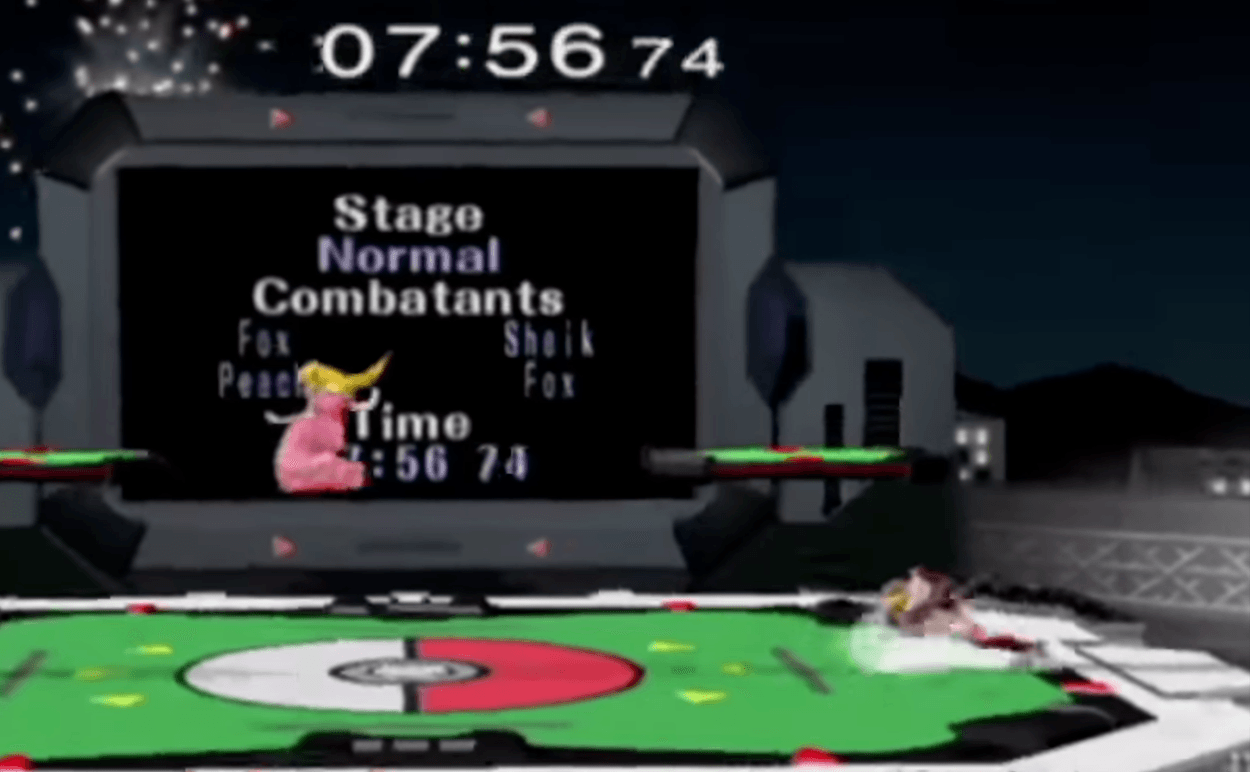
Here you see that one teammate, the “point” or “carry,” is in the front, while the “support” stays some distance behind. Generally, the support should not try to cross up the point character, as crossing the wires can lead to undesired chaos. Ideas like these are the basis for organized teams play. You can easily find the like in other doubles guides. Doing so will give you a decent foundation that will allow you to be a competent teams player. If you are at all like me, competent is not nearly good enough.
Let’s explore that simple idea further. We will use ‘not crossing up the point character’ as a foundation for a much more complex and much stronger set of game plans. In Melee, space and time are both implicit forces that make engagement an eventuality. In singles, arising questions answered by the players are when, where, and how the engagement between two characters take place. This is deep enough in itself to create an unsolvable neutral game. In doubles, each party has two characters at their disposal. That makes this set of questions that much more complex.
To put it concisely, my approach to Melee teams neutral begins with identifying the win conditions of the game. In both formats of Melee, making choices based on risk/reward ratio is a surefire way to improve win rate.
Friendly Character Composition
To generate an effective team’s strategy, it is useful to take into account the strengths and weaknesses of each team composition. Examples are often better than discussion so let’s look at a scenario.
You and I have formed a Fox/Peach team. Fox and Peach work dramatically different as point characters within this composition, which we can use to our advantage. After all, there is no rule preventing teams from switching point characters mid-match, and liberal use of regrouping can pay dividends.
Peach is excellent at dealing damage and generating chaos from the point position. If Peach wins the engagement, the opponents can accrue percent rapidly. If Peach loses the engagement, there’s a good chance she will trade and be knocked away without too much harm. This is excellent risk/reward, especially with the highly-mobile Fox supporting her. He can follow up on enemies that she sends flying his way, and bail her out of trouble with his quickness if things go sour, preventing combos. The only danger for Peach is engaging directly when she is at high percent against particular opposition. An errant knee, Fox up smash, etc. threatens to take her stock with only a bit of damage as compensation. The risk/reward ratio isn’t nearly as good if the enemy point character has an easy way to kill Peach. In this situation, she will often need to play more defensively and let her partner take the lead.
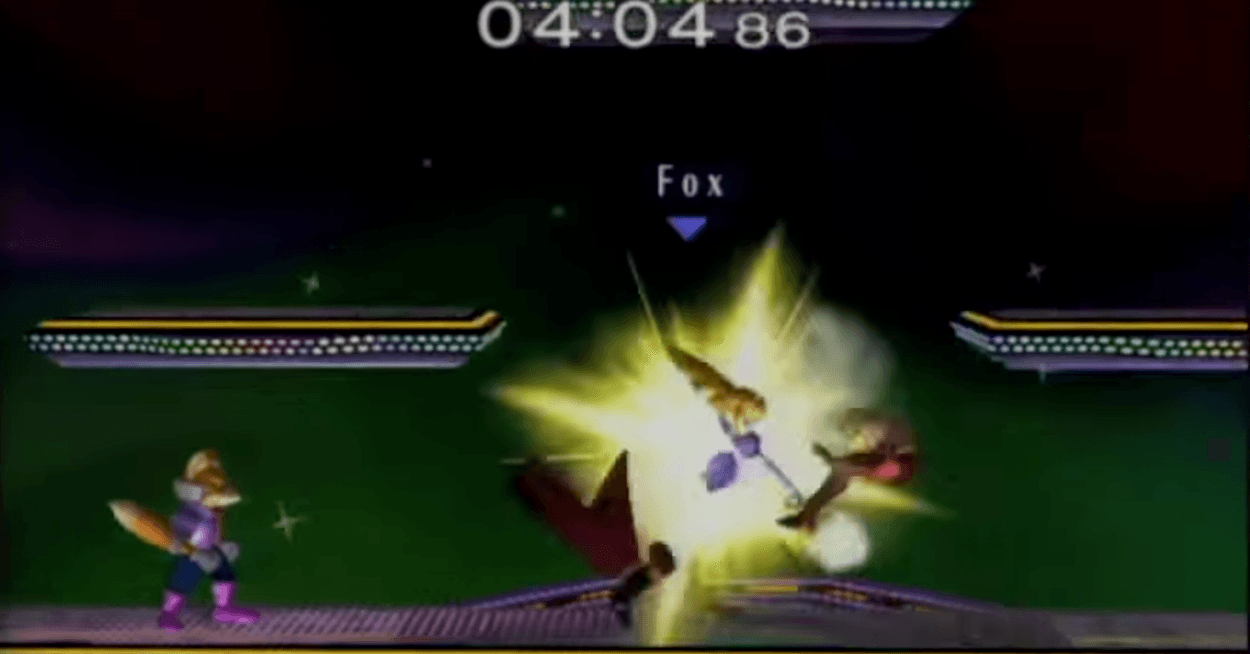
Fox in the point position can be played a myriad of ways. Perhaps the most effective way to deploy Fox is for the dispatching of high percent enemies. His kill options are plentiful and quick. Against a high percent floaty, it is usually better to put Fox in the point position, as Peach will most often just trade percent without removal of the opposition’s stock while Fox has a superb chance of delivering the finishing blow in comparison. When Fox’s princess partner is at high percent and both the opponents are at low percent, he ought to play a bit differently. Under these conditions Fox can exercise his quickness to force his opponents into a state of Zugzwang. Zugzwang, for those unfamiliar, describes a game state where a party has no favorable moves but is forced to choose one. It is the “pick your poison” of positional games.
Now that we have a working understanding of some of the differences this singular team composition has based on formation, we can begin to develop strategies easily. If we are both at low percent against a Sheik/Peach team both at high percent, we’ll unleash Fox’s kill moves by putting him on the frontlines. Double Fox team at the beginning of the match? Get Peach in the mix and she’ll do serious damage with her stellar hitboxes and tanky qualities.
A natural question at this point arises: How do we execute this strategy in real time? Communication is often the answer. A simple callout, “Get ready to switch… NOW!” can go a long way. Let’s continue with another example from our Fox/Peach heroes. Everybody but friendly Fox is at KO percent, and Peach is in the frontlines. The Fox’s pilot says, “switch switch switch.” Understanding that a formation shift is needed, Peach simply rolls backward and allows Fox to become the spearhead. Other ways to rotate positions include attacking through your partner’s shield and use of platforms from one member while the other mobilizes on the ground.
Opposing Team Composition
It is roughly as important to examine the opposing team composition’s strengths and weaknesses. Let’s build on the previous example even more. Our (us as Fox/Peach) opponents for this example will be Captain Falcon and Jigglypuff. At first glance this team seems pretty frightening, especially for our Peach player. Falcon has one of the dreaded early kill moves that mitigates her ability to play point effectively. Damage is (can be) less meaningful for killing Falcon directly, nerfing her frontline capabilities even further. Jigglypuff on the other hand can simply choose to fly away from poor engagements from Peach and is quite capable of stuffing her attempts at creating chaos. Puff is also one of the few characters that can threaten Peach offstage, making it a potentially lethal 1 on 1.
A closer look reveals that Falcon/Puff has some readily exploitable weaknesses. Falcon’s moves are rather slow, and without room to exercise his excellent dash dance, Falcon begins to look less like a high tier. This will be the foundation of our strategy. Peach and Fox can both box Falcon out with their quick moves. Once Falcon is in the corner, the enemy is in a state of Zugzwang. If the enemy makes no moves, the easily edgeguardable racer will end up off the stage and in peril. The other prospects do not look so nice either.
Falcon can attempt an escape on his own. This is usually accomplished by rolling or jumping, which can easily be thwarted by whoever between Fox/Peach is in the support position and covering the center of the stage. The other option is to call in the cavalry, namely Jigglypuff.
The Balloon Pokemon will feel obliged to come help its Falcon teammate. This can be exploited. Jigglypuff is a threatening character in teams partly because she doesn’t need to engage under normal circumstances and can get away with retreating. This go-round, there is not time for waiting or disengagement. A Jigglypuff known to be approaching is relatively simple to punish. It is conceivable that after getting enough reps in, our Fox/Peach team can cover every option the opponents try to use as an escape. From that point, the only task remaining in formulating our strategy is to learn how to force Falcon/Puff into this situation, but that’s a different article.
A Few Notes on the 1v2
There will be times throughout the course of a match in which any player will inevitably be left to fend for himself/herself against both members of the opposing team. How about we use similar strategy forming tools as we have thus far. First off is judgement. 1v2 is invariably a relatively low risk/reward to be playing in. This is the most obvious stipulation wherein the optimal choice is to disengage. Run the clock a bit. This will enable your teammate to return with respawn invincibility. With the aid of being intangible, bailing you out of a tough 1v2 becomes trivial, and instead of losing an extra stock, the tides have turned.
Methods of Disengagement
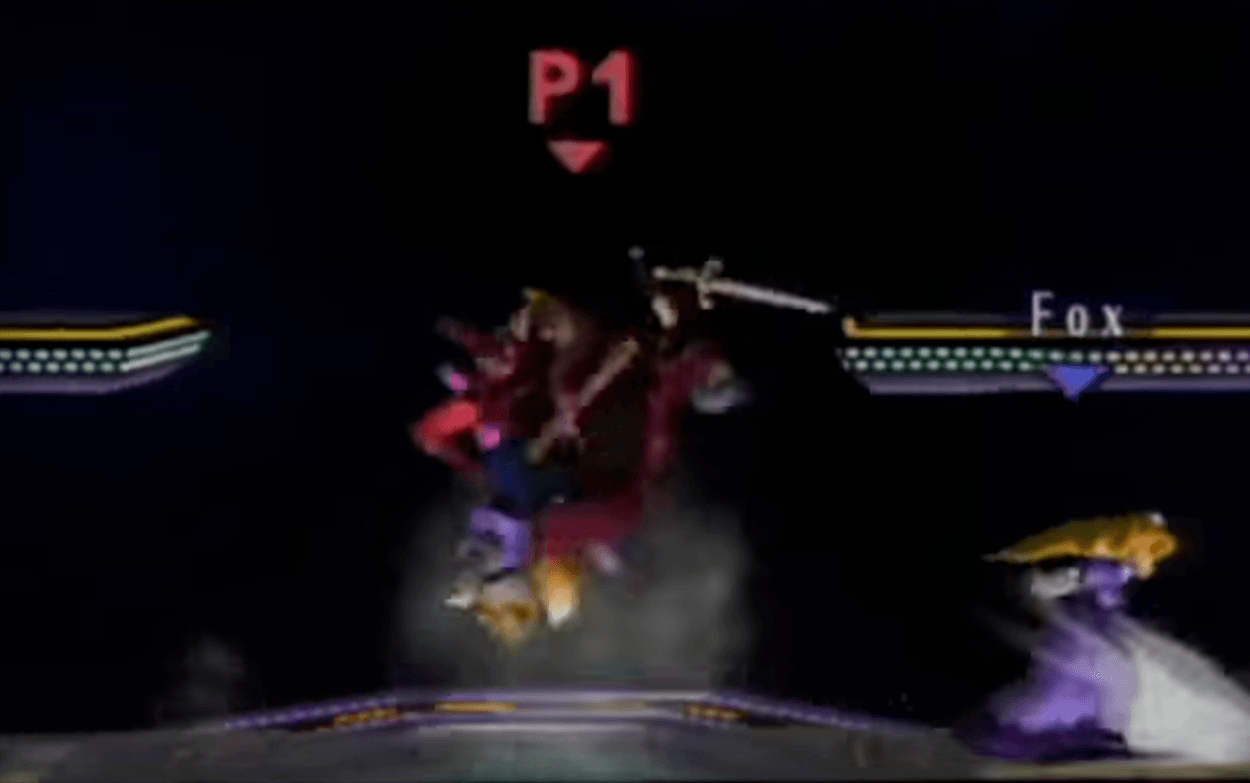
How exactly can one wait out the unfavorable situation? A universal tool is to hop on a platform and shield. By the time your opponents dislodge you from the platform, your teammate will be back and raring to go. Other characters have other strong stalling tools. Floating offstage, shino stalling, and missile spam are but a few ways to slow down your enemies.
The theorist reader will quickly realize that disengagement has some intense downfalls. If your opponents have you “sandwiched” between them, it will be quite likely that they land an opening blow and convert into a combo. Running is not an option if your opponents can easily cover your escape. This is where disengaging offensively comes into play. You’ll have to fight yourself out. Perhaps one of your enemies is at a high enough percent that a solid hit will send them far away. This will afford you a doable 1v1, or an opportunity to use one of the disengagement strategies in the previous paragraph. Perhaps your enemies are prone to chasing you down. If this is the case throw out defensive hitboxes to keep them at bay.
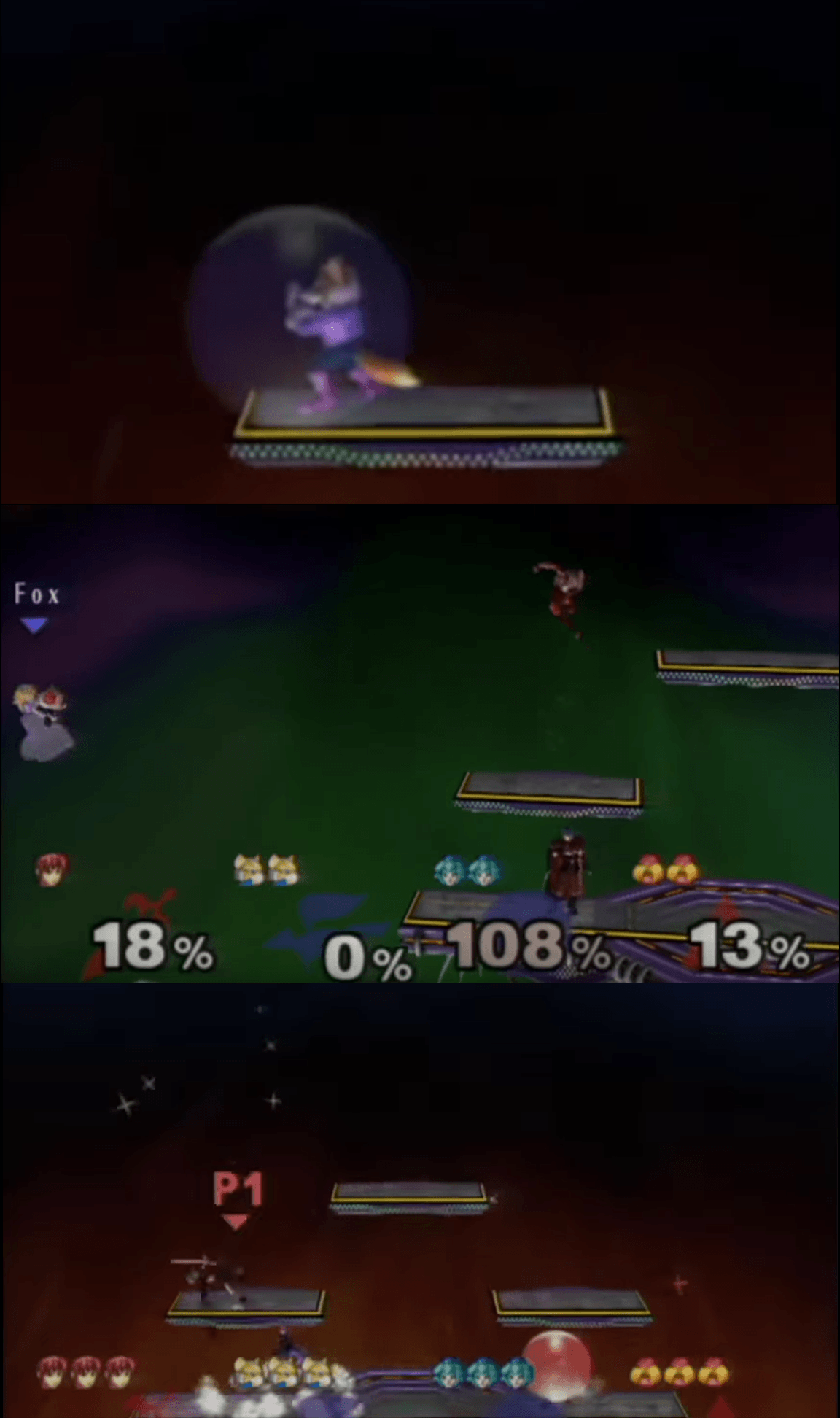
Top: Fox lightshields on a platform to disengage fully.
Center: Peach stalls offstage.
Bottom: Fox fights his way out, a method of offensive disengagement.
Conclusion
This edition of We’re Talking Teams has given the basis for developing high-level strategies. By assessing the strengths and weaknesses of each teams’ composition, selecting an appropriate strategy becomes trivial. In a future volume, we’ll expand the strategy-forming toolset by looking at role assignments outside the typical point-carry duality. We will explore how to maximize tech chasing effectiveness by working as a unit. We will investigate rigid prophylactic playstyles. For these things and more, keep your eyes peeled for the next edition of We’re Talking Teams.
Like our content? Support us by getting our merchandise in our shop