




Blogs
Comprehensive Guide to Backboard Double Touches
Stego111
Fri 27th Jul 2018 - 5:29pm
Backboard double touches (BDTs) have been a part of the game since its inception. They are used extensively in pro play, where just getting a shot on target is usually not enough to score. In RLCS Season 3, Deevo performed many BDTs with a high success rate which ultimately led his team, Northern Gaming, to victory. But now, no longer just for the elite, backboard double touches have worked their way down into the amateur level.
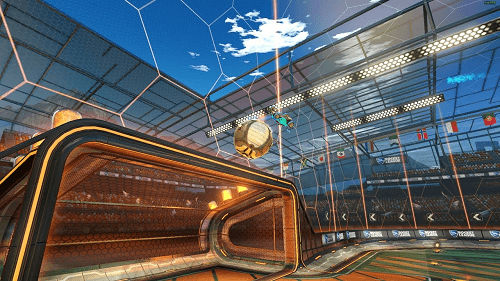
Lookin' good.
There are three main components involved in performing a BDT. The first touch, where you aim your ball towards the backboard, the approach, where you need to adjust your speed to reach the ball, and the second touch, the part where you slam the ball over the top of your opponents!
The First Touch
Your first touch can come from anywhere on the field. Maybe you chipped the ball up to yourself after an opponent’s poor clear attempt or maybe you redirected a teammate's pass. Whatever the case is, your objective is the same: to get the ball to bounce off the backboard.
The area that you should be aiming for is a large rectangle that is just above the opponents' net and extends about 2 ball widths to either side. This will give you the best chance to complete your shot. Too high or too far to the side will be too tight of an angle to hit reliably. The further away from this rectangle you are, the more time your opponent has to react to your shot as you are impacting the ball from further away.
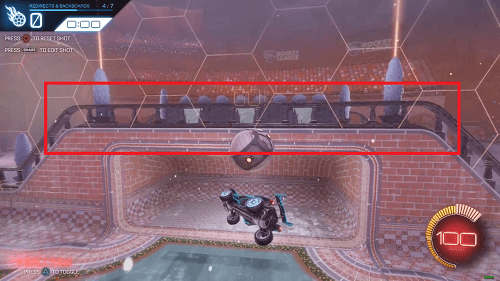
This is the area you want to aim for.
When you are making contact with the ball, it is important to remember that you are playing a physics-based game and as such, when you impart a force onto the ball, it applies a force back onto you. This isn’t as important with basic aerial shots, but we want to be making a fast recovery in the air.
There are two ways to counteract this effect. Firstly, you can dodge into the ball. This gives you a solid contact with the ball, but often times it will make your approach more difficult as you cover too much distance. Secondly, and the way I recommend, is you can air roll through your contact with the ball. By this I mean you should air roll slightly before the impact and hold it on slightly after.
If you are hitting the ball from below you will want to boost through your contact as well, this will help keep your elevation and will help you use less boost in the long run. Once you have made a solid contact with the ball, you will want to start following its direction.
The Approach
An often overlooked component, a proper approach will make your second touch come naturally. Most of the time, after your first contact, you will be moving towards the net too quickly. To rectify this, you will need to lean your car back and boost up and away from the ball. This should give you the distance you need. Other times you will not be moving fast enough and you will need to boost towards the ball. Once again, you need to be careful as it is very easy to go too fast.
Your aim should be to adjust your speed so that you contact the ball about three ball widths from the wall. Too close and you risk just squishing the ball up against the wall, too far and your opponents will be able to read the bounce and get a clear or read your shot and get a save.
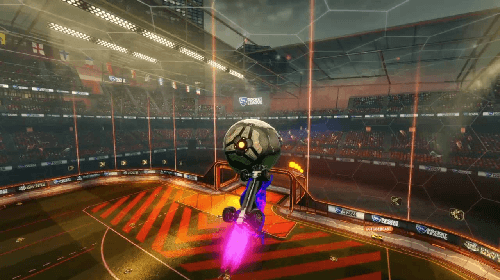
This player should slow down if they want the double.
So now you have the correct speed, but what about the angle? This is by far the most difficult part of the BDT. Not only do you need to be able to judge the lateral movement of the ball, but the speed of the ball (and even the spin) can change the bounce drastically.
To get better at reading the bounce, try slowing down more than you would expect and hover in the approximate area for a brief period of time. This way you will have time to adjust if your estimate is off. Of course, this means your second touch will be further away from the wall than would be desired, but this will improve with time. Eventually you will be so good at reads that you will be able to get to the ball in one fluid motion, which leads us to the final component.
The Second Touch
The second touch should be the easiest part if everything was done correctly up until this point. At first, you will want to just get the ball on target, but as you get more comfortable you can try aiming the ball. If at all possible, you should try to avoid having your shot bounce off the floor. This often leads to a saved ball since the goalie will barely have to move after all your hard work. Try shooting the ball higher and higher until you are able to just tuck it into the top of the net out of reach of any save attempts. Don’t forget you can hit the ball with your wheels to get a softer hit and drop the ball from higher up easier.
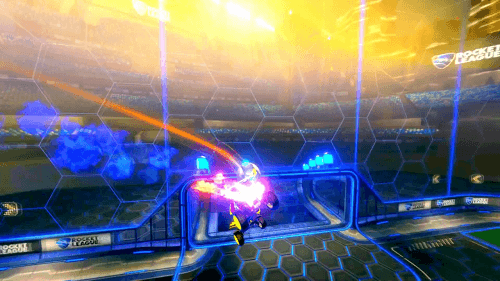
A bit far away to get the ball into the upper half of the net.
Training
Training BDTs are fairly straightforward. Find any pack you like, be it wall shots or plain aerials and just try getting your first touch onto the backboard. From there, add in each component in sequence. Make sure to keep in mind the tips mentioned above.
BDTs are one of the most important mechanical skills to practice as you reach the higher ranks. While they are very difficult to perform, this is offset by their reliability. A fast touch on target is rarely saved. Keep practicing those reads and you will have highlight reel plays in no time!
Like our content? Support us by getting our merchandise in our shop