






Blogs
How To Improve Your Game

Between New Year’s Resolutions, getting new keyboards for Christmas, and Jae Dong starting to stream on Twitch, there are plenty of reasons for players to start playing StarCraft 2 a bit more heavily during the holiday season and beyond. Given the competitive nature of the game, most players will strive to hit a new ladder before school starts up, but how can you do it? There is no catch-all advice when it comes to improving. A person must account for the level of play they are currently at in order to perfect their training sessions.
If you’re Bronze or Silver, you might need to go watch Shaun 'Apollo' Clark’s tutorial videos for your race on YouTube to get build orders and some core tips on how to play each race. If you’re Masters, then maybe you should jack some builds from your favorite streamer and play around with them a bit. The main thing is that you understand how you personally can improve the most.
There are three main pillars at the heart of StarCraft – mechanics, strategy, and game knowledge – and there are two trains of thought regarding improvement of play. You can either fortify your weaknesses (e.g. working on your macro if you tend to have 15 workers queued up by the 16 minute mark) or just push through with your strengths. Neither of these is wrong, per se.
However, if you want to have lasting improvement, the best method is to work on your weaknesses. Cheesing every game because of your good micro will net you more wins in the near future, but it may not translate to the best possible practice time if you’re looking to climb two whole leagues by next year.
MECHANICS
“Mechanics” is a very broad term. Ranging from larvae injecting and pylon building to your ability to target fire and scout for incoming drops, mechanics are everything that your hands do during the game. Macro (building stuff) and micro (killing stuff with your built stuff) are the two halves of mechanical skill, and it’s key to work on both of these – not just one – if you’re looking to improve in the long run. Generally speaking, the lower your level, the greater the effect you will see out of sheer mechanical improvement.
If you’re building twice as many workers as your opponent while essentially doing the same strategy, you will outright win unless you start /dance-ing too much in fights. If you’re a Bronze player, going a whole midgame without getting supply blocked has a more profound effect than you might think, even if it’s only a 10-second block. If you’re Platinum, then working on mechanics might involve target-firing your Stalkers better in PvP or being more active with your Infestors in ZvT. The point is that you must identify what you’re doing wrong. While watching a replay, your brain might want to focus on that sick blink you did into the main, but it’s more important to notice that all your Nexi had full chrono energy for a solid three minutes after that while you were microing to kill probes.
STRATEGY
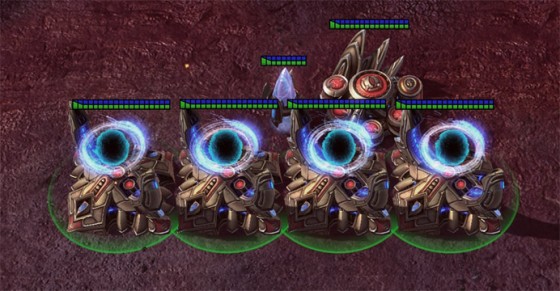
Strategy can often win games despite the skill level difference between you and your opponent. Holding a 4-gate or proxy-raxing a hatch-first Zerg can just cause you to simply win. Period. However, strategy extends beyond just build orders. Strategy also encases things like “Where should I position my army?” and “I should stop dropping now that he has mutas.” An important thing to note is that different strategies require different levels of mechanical skill. IM_MVP may have won a TvT with a greedy mech style, but if your macro and army positioning aren’t immaculate, you will probably not get the same results when using that build.
Also, there is not just a single meta-game in existence; each league (and the higher/lower portions of a league) has a unique meta. You have to pick out a style of play that fits your particular league’s meta-game. This doesn’t mean that you have to go for the same strategy that every other Zerg in low Masters is doing, but you must go for a strategy that is good against what everyone else is doing, or you risk a frustrating losing streak that may not be a result of inferior skill at all, but rather just lucky hard-counters by your opponents. To improve your strategic capacity, you can either study your replays extremely hard to figure out what you’re doing wrong or you can watch professional players stream and see how they react on a strategic level to seeing certain things. Keep in mind – again – that not everything a pro does will work for you, but it is generally a fantastic point from which to begin.
So maybe you have some great macro, your engagements are well-controlled, and you have sick builds and decision-making that can rip opponents apart. What’s next? Well, to perfect a given style of play, some number-crunching may be involved. The more you know about the game, the better. Knowing how much your upgrades cost can save you a bit of APM if you were about to try and buy a 200-gas upgrade with only 174 in the bank. Likewise, knowing exactly how many hits it takes for unit X to kill unit Y can keep you from getting a unit down to 2 HP before blinking away because you thought it only took five shots instead of six.
Another thing that is invaluable to know is timings. If your Overlord scouts their third gas going down at X time, what strategies can they not possibly be going for? Guessing what might be coming is good, but knowing what can’t be coming is much better. If you already know what all-ins you can pull as a Protoss at the 9-10 minute mark, then study how each of them work against different timings of pools/gasses/hatches. Think beyond yourself, think of what you opponent must or must not be doing. If watching replays of your opponents doing certain builds isn’t helping enough, then play that race yourself for a few games. Even if you can’t figure out how to counter a strategy, then figure out what’s hard to defend against and do it. Everything you can do to make the game harder for your opponent will make the game easier for you (even if it required a bit of studying beforehand).
Regardless of which method you choose to practice by or what you try to improve, the key is to practice, practice, practice. The more natural the game becomes, the easier it will be for your skill to grow, and the more you can use your brain to think about what you’re doing and why you’re doing it, while your hands naturally do everything you want them to do. Play hard, play smart, and climb those leagues. Good luck on meeting your New Year’s Resolution’s goal.