






Blogs
How To: Be Aggressive in Smite

While Smite is fast paced and action packed, there are times for aggression and times for passiveness. Part of improving your game play involves knowing the flow of the game, when aggression is appropriate and when it is not. However, there is distinctions between playing aggressive, not playing aggressive, and playing passively. Here are some scenarios to help you understand the differences.
Scenario 1 – Early Game Aggression
At the beginning of the game positioning is extremely important. Whether you are going to steal buffs, or just wander the jungle, getting caught out could be deadly. But having good level 1 characters can allow you to be aggressive early game. Some characters who can be aggressive early game are Sobek, Artemis, Anhur, and Arachne, among others. If your team catches an enemy out of position before the game starts, and you have strong level 1 characters, then being aggressive can earn you a kill, first blood, and a slight advantage going into the game.
Scenario 2 – Early Jungle Invasions
Counter jungling is a good strategy to shut down an enemy jungler, but what can you do if the enemy jungler is invading your jungle and taking your farm? Calling for help from your allies and punishing the intruder is the most effective way to shut down their strategy. They are wandering on your turf, and if you can’t 1v1 them safely, calling for help is crucial. If your jungler is being pushed out, keep on eye on the mini map, put some wards down, and be ready to jump on the enemy as soon as they pop up on the mini map. Being aggressive towards counter junglers is the key to avoid future fed ganks, help keep your jungler strong, and win the laning phase.
Scenario 3 – Team Fights
During the mid game phase, the tank or guardian will start wandering after finishing Midas Boots and sometimes look for gank opportunities in the other lanes. Once this happens, listen to your tank, whether they call retreat or attack. If they recognize a good opportunity, make sure that you follow up their CC or let them know before they attack that you are not ready. If your tank recognizes that the gank opportunity has passed and calls for a retreat, do so. Tanks are there to initiate team fights and provide CC, but if there is no follow up damage, their efforts will be in vain and they could be slain. While tanks might make mistakes, committing to their calls can make a potentially bad play a decent one.
Scenario 4 - Baiting
Sometimes you find yourself with low health and being chased by an enemy. If one of your ally flanks the enemy god, turning on the enemy can earn you a kill. This works well if your ally can secure the kill, or if you have enough life steal items to sustain yourself. Understanding how much you can do with the amount of health you have is crucial to higher level play, and often highly skilled players will scrape by with their HP in the double digits. Turning on an enemy player with low life is an example of not being aggressive; while you are running away, there is also kill potential that you can capitalize on.
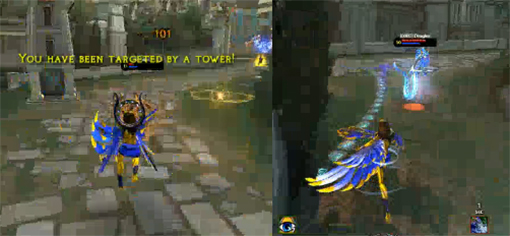
Acipere, playing Isis, tower dives an enemy Tyr, and uses Wing Gust for the kill. However, Acipere has caught himself between the enemy tier 1 and 2 towers, with the only escape being the entry into the jungle. The enemy Ao Kuang cuts off his escape with a well placed Tornado, leaving Acipere with no choice but to run through the enemy tier 1 tower.
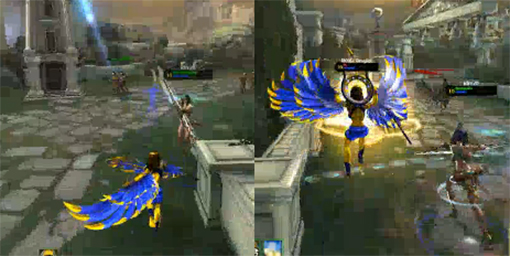
Luckily for him, his ally Neith arrives with a minion wave, so that the tower doesn't target Acipere. Turning on the Ao Kuang, Neith uses Spirit Arrow, and Acipere secures the kill with another Wing Gust.
Scenario 5 – Pushing Objectives
Say that one of your phoenixes is down and fire minions are pouring into the base. Being aggressive is key here, as playing passive will ensure that the enemy team will destroy another one of your phoenixes. Press the lane with the dead phoenix, and take their phoenix as well. Send a hunter or assassin with Shielded Teleport or another escape mechanism to split push another lane, so that the enemy will be spread across the map. By pushing the lane that your phoenix is down in, you will eliminate the threat of fire minions, and hopefully gain a phoenix as well. If all of the members of the other team is on one side of the map, grouping up and pushing the towers on the opposite side of the map will allow you to take towers quickly uncontested.
Other objectives that call for aggression are the Gold Fury and the Fire Giant. If a few members of the opposite team are dead, especially their tank, these objectives cannot be contested as easily and should be completed as soon as possible.
On the other hand, if you notice that these objectives are being taken by the enemy team, being aggressive will help you kill some enemies or even the objective. Typically, AOE ultimates or abilities, such as Zeus’s Lightning Storm, Ao Kuang’s Tornadoes, or Isis’s Circle of Protection will deter enemies from taking objectives, or help you steal objectives yourself. Ra’s Searing Pain or Ao Kuang’s Spirit’s Tempest can help secure the objective as well, as they are typically harder to hit and can provide a lot of burst damage fairly quickly. If you are playing a tank, waiting until the objective hits the 25% health mark, rushing in, and using Hand of the Gods will secure your team the objective. Even if you die afterwards, denying the enemy the Fire Giant buff is more important.
While Smite can be an aggressive game, there are also times in which aggression is not the best idea. In certain times aggression would actually be counterproductive, and playing passive would keep you in the game.
Scenario 6 – Lost Objectives
When two or more of your phoenixes are lost, or the enemy has the Fire Giant buff, playing a little more passive is required until at least your phoenixes respawn. Your team should not be split pushing, unless the rest of the team stays to clear the fire minions and the split pusher can sneakily backdoor the minotaur. You should not be very aggressive during this time, but if an enemy comes too close, being aggressive can help you eliminate any targets caught out of position. However, if the enemy sees that two of your phoenixes are down, more than likely they will try to go for the Fire Giant buff. Depending on how pushed up the lanes are, contesting should be considered.
Scenario 7 – Tower Diving
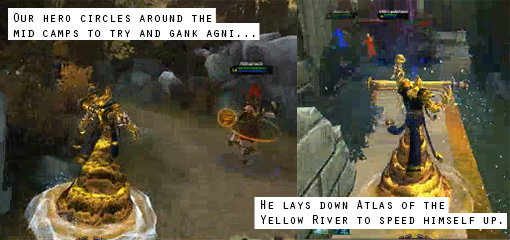
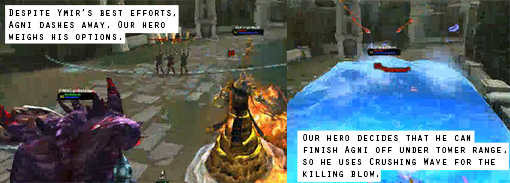
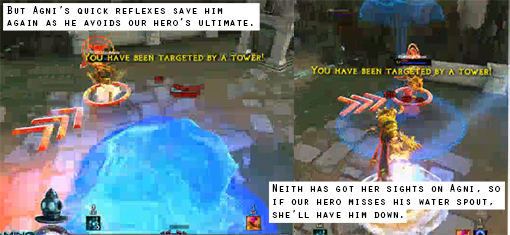
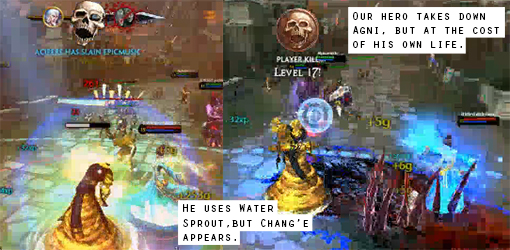
Acipere, playing He Bo, lets Agni slip through his fingers, but decides to continue chasing, even in tower range. Since he could not kill Agni with his ultimate, he had to wait until the cooldown on Waterspout ended and Neith had released her ultimate. The entire time that Acipere was waiting, he was taking damage from the tower, and on a character as squishy as He Bo, this was the mistake that cost him his life. Chang'e seems to appear out of nowhere, as his tunnel vision and camera was only focused on Agni. By the time Chang'e had arrived, Acipere's allies had already backed out of the tower, leaving Chang'e to clean up.
This is an example of overaggression, after missing many crucial abilities on Agni, he should have given up the chase, espeically if Agni was a low priority target with only a few kills. By trading his life with Agni's life, he did not accomplish very much for his team, especially if Agni was worth less gold than he was. After seeing the kill potential vanish, retreating or pushing the tower would have been a better choice.
Scenario 8 – Allies Getting Caught
Sometimes there is not much you can do for an ally who has found himself alone with the rest of the enemy team. In that case, let him go. Recognizing when an ally or an enemy is already considered dead can help you get out of a situation safely, or save your ultimate for a more appropriate time.
Scenario 9 – Maintaining a Lead
A 4 - 6K gold lead is not a very good buffer between teams. If your team is ahead, but loses a few teamfights or objectives, a 6K gold gap can be closed very quickly. Not playing aggressively or passively can help you maintain that lead. Focusing down targets when the opportunity arises, keeping wards on the map as you push, and grouping up are examples of not being aggressive or passive. By playing smart and not overstaying your welcome, maintaining even a 4K gold lead can carry you to victory.
Hopefully some of these examples will help you understand when passive play will help you, and when aggressive play will help you. Typically, Smite favors the team that is more conservative, but knowing when aggressive plays will turn the tide of a teamfight is essential. Saving ultimates for when they are truly needed can give your team a huge advantage, and knowing when to use the ultimate is part of the learning process for each god. By pushing objectives over chasing kills, you will have more gold and expierence over your opponents, and recognizing when to kill is key in balancing your gameplay.
Want to see how aggressive plays work in the mid lane? Acipere streams daily from 6 – 8 PM EST. Artwork done by Elizabeth Beals.
As always, let me know what you think about how aggression works in Smite in the comments below or tweet me@SunniZepha! You can find a complete list of my articles here.