





Blogs
The Doctor Is In: An In-Depth Mercy Guide

Playing support requires a special mindset. Support heroes have tool-kits that revolve around helping their team do their job. Playing support has less to do with what you can do as an individual, but more so what you can do as a team. Supporting isn’t always considered the “hero role,” but try winning without one on your team. Most pro-teams run two support heroes when they compete.
Some people think playing support is easier than playing DPS or tank. While their tool kits might be simpler, playing them effectively is not so easy. When you go into a match as a support, you are playing the most targeted character on your team. Most players strategize to kill the healer first, then they make a play. Staying alive to help your team is what makes supporting difficult. You have to make good decisions that enable your team to push and win. It’s impossible to be helpful when you’re waiting 10 more seconds to respawn. Mercy is one of the most targeted heroes in the game, so utilizing her tool kit might be easy, but staying alive to help your team is not so easy.
Mercy was a fan favorite for months before her ultimate got nerfed in July 2016. We saw Mercy fall to the bottom of the meta, and Lucio and Zen quickly rose to the top. Since then, Blizzard has worked hard on balancing Mercy without making her too over powered. Recently, Mercy was buffed so that her health starts regenerating after one second when it was previously three seconds. This buff to her survivability and her current abilities are making her a viable pick again.

PROS
- High single-target healing
- High mobility (with team-coordination)
- Ultimate: Resurrect
CONS
- Easy to kill
- Coordination-dependent
- Blaster has low damage/slow rate of fire
ABILITY BREAK DOWN

Caduceus Staff
- Healing: 60 per second
- Damage: 30%
- Range: 15 meters
Her Caduceus Staff is her primary fire. She restores 60 health-per-second and can boost a teammate’s damage by 30%. Sometimes Mercy can stay behind her teammates in the back lines, but there are times when Mercy’s healing can be used in combat. With a constant beam of 60 health-per-second, Mercy can heal 200-health heroes in less than 4 seconds. Mercy has the highest and consistent rate of healing, so unless her teammate is taking more than 60 damage-per-second, she can keep them up.
Mercy sometimes has to make the hard decision of prioritizing whom to heal. When you have 5 teammates who are taking damage, focus on keeping people alive rather than filling health bars. Pay attention to people who are getting focused, and alternate your beam on everyone to make sure they stay up. Sometimes you have to let some of your teammates die. Making that decision is a last resort, but it is more important that you stay alive to help your team rather than follow a dying teammate back to spawn. You don’t want to die to the same enemy who killed your teammate.
Mercy is primarily a healer, and healing is the fastest way to charge her ult, but she can offer some significant damage support to other heroes. For her damage boost to be effective, Mercy must be boosting a teammate at the time of impact on the enemy. For example, if Mercy is damage boosting a Pharah when she fires a rocket, but Mercy stops her beam before the rocket hits, Mercy’s did not boost that attack.
Mercy cannot boost Junkrat's ultimate or any turrets in the game. She can boost ults from Pharah, Reaper, and Soldier 76. Her damage buff can be useful outside of ultimates, too. For example, a damage-boosted Pharah can one-shot a Tracer and nearly take out 200-health heroes with a direct rocket hit.

Caduceus Blaster
- Damage: 20
- Clip Size: 20
- Rate of Fire: 5 rounds per second
- Reload: 1 second
- Projectile fire
Mercy’s Caduceus Blaster is her only defensive weapon. There is a lot of debate as to whether or not this weapon actually adds to her survivability. The gun does 20 damage-per-shot, but it is projectile firing. This means you need to lead with Mercy’s gun, or anticipate the enemies’ movements to target them. Mercy’s gun has a clip size of 20 and fires 5 rounds per second. Mercy can do a total of 400 damage over 4 seconds if she lands all of her shots. That is incredibly slow compared to the amount of damage other support heroes can do to defend themselves.
There are very rare moments when Mercy should pull out her pistol to attack. Your primary focus should be on healing your team. However, if your teammate has almost killed an enemy but ran out of ammo, pull out the pistol to finish the enemy off. Other than that, put the pistol away and pull out the Caduceus Staff.

Guardian Angel
- Ability to fly towards living or fallen allies
- Range: 30 meters
- Cooldown: 2 seconds
Guardian Angel allows Mercy to fly across the map to wounded teammates. This gives her the opportunity to help her team, but Guardian Angel also gives Mercy the chance to run from enemies. You have to be able to coordinate with your team to use this ability effectively. Communication is a big part of playing Mercy, so keep that in mind before solo queuing as her. There are a lot of opportunities for things to go wrong. Your teammates might not be in the team chat, you might get a team composition that doesn’t support Mercy, or you might get a map that Mercy just isn’t very strong on. Guardian Angel gives Mercy exceptional mobility, but it is completely reliant on your team and the heroes they pick.

Angelic Decent
- 20 health-per-second after not taking damage for 1 second
- While airborne, press and hold the jump button to slowly fall to the ground
It’s pretty much necessary to kill Mercy in one burst now or she can Guardian Angel to another teammate out of combat and regenerate health. Previously, it took Mercy 3 seconds to regenerate health. By then, most characters could unload a clip, reload their weapon, then hunt down Mercy. Angelic Decent allows Mercy to stay in combat with her team, rather than hiding behind cover to regenerate health. The difference between 3 seconds and one is the difference between hiding from attacks and dodging attacks.
Stay moving. Guardian Angel has a very low cooldown, and it gives Mercy the perfect outlet to regenerate her health.

Resurrect (Ultimate Ability)
- Revives fallen allies
- Range: 15 meters
- Duration: 1 second cast time
- Resurrected allies can move after 2.25 seconds
Mercy’s ultimate ability is a game changer… when used correctly. There is nothing worse than burning all of your team’s ults to wipe the other team only to hear, “Heroes never die!” from an enemy Mercy. It might be a strong ult, but it still requires strategic planning and coordination with your team.
One of the biggest misconceptions is the bigger the Rez, the better! Some Mercy players see “x3 teammates down,” and they ult just to get the extra Rez’s… then the enemies who killed her teammates in the first place kill them again. Mercy’s ult, just like any other ultimate in the game, requires timing and placement. A well-placed one-man Rez is more useful than a four-man ill-placed Rez. Know when it is best to group up rather than waste your ult so you get the extra ults for your stats.
If you have three people down, but they are in the middle of the entire enemy team, best wait for your teammates to respawn. Otherwise, the enemies will kill your 3 resurrected teammates, and your ult will be wasted. Just like any other ult in the game, you need to combine Mercy’s ult with other ults or team pushes.
If you are looking for a x5 Rez, and the other team sees you, they are going to target you hard. Wait for your team to make a few picks, and then go for a two-man Rez to keep the push going. Just remember, Mercy’s Rez isn’t about her. She is a support character, so always think about how her abilities are going to help your team.
Mercy players often get instructed to hide in the back when they have their ults, but this is not a consistent method. Mercy has to be with her team to stay safe. If she is hiding in the back, she will get flanked and killed. It’s been over six months since Overwatch was released, and players have figured out why Mercy is hiding in the back.
ROLE AND PLAYSTYLE
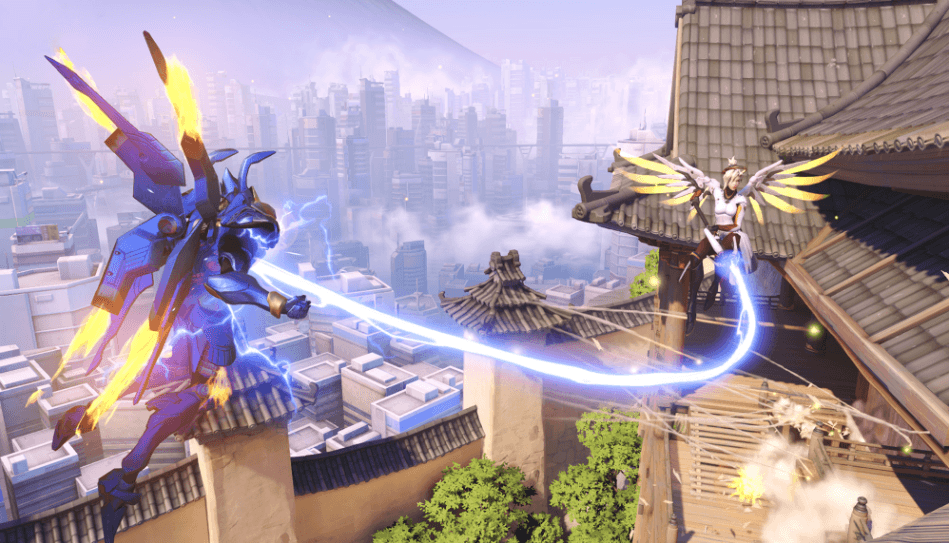
Mercy is a single-target healer, like all of the other healers besides Lucio. She can do a lot of healing, quickly, and consistently, but she can only heal one teammate at a time. This doesn’t mean you should only focus on one teammate. In fact, the term “pocket healing” is often looked down upon, as it should be. Mercy’s goal should be to keep all of her teammates in the fight. Keep an eye out for every one of your teammates, and know who you can and can’t help. If your D.Va needs help front lines, you should prioritize her over your flanking Genji who is mobile enough to easily grab a health pack.
Dive compositions became popular this summer when Lucio rose to the top of the meta. While you can use Mercy in a dive comp, she’s generally not picked. Mercy doesn’t pair well with heroes like Genji, Tracer, Winston, or Sombra because those characters can dive into the other team to disrupt and get kills. This leaves Mercy really exposed to fire.
Try pairing Mercy with heroes like Pharah, Soldier 76, Reinhardt, D.Va, and Zarya. You need a tank like Reinhardt or Zarya to hold the choke or push with damage behind them. Pharah can give Mercy an escape route high above the other team. Now that Pharah barely has to touch the ground, Mercy can stay completely airborne with Pharah.
Flank-heavy DPS heroes do not coordinate with Mercy. She is an excellent support, but she requires some protection from her teammates. She can work well with a lot of heroes, but her ideal team comp is slower than the dive comp.
COUNTERS
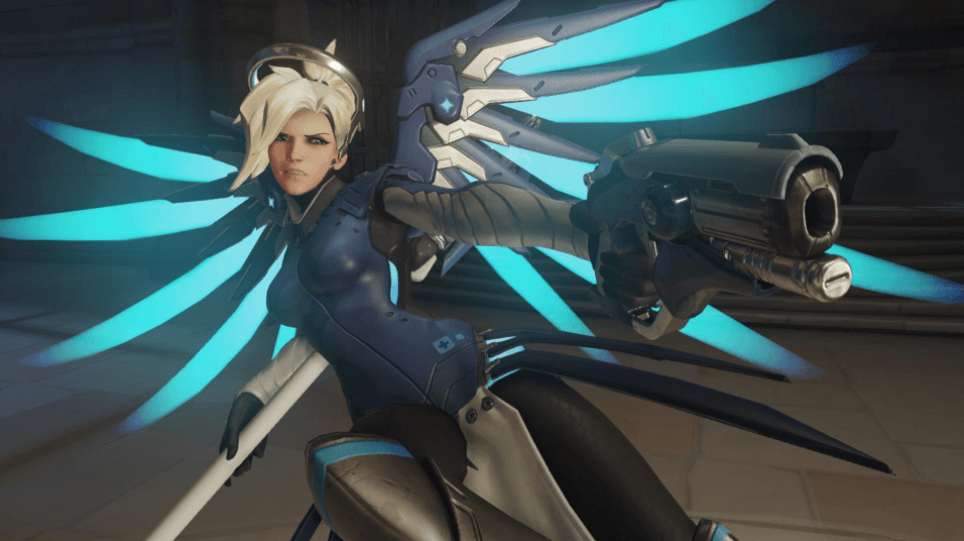
Mercy needs to keep an extra eye out for flankers like Tracer, Sombra, and even Reaper. Sombra has the ability to hack Guardian Angel, but she cannot stop Mercy’s primary fire of healing and damage boosting. Her EMP can postpone Mercy’s Rez, but it cannot cancel it out.
Divers should also be on Mercy’s radar. Stay away from an enemy Winston. His weapon can lock on to Mercy, and although it doesn’t do a lot of damage, Mercy only has 200 health. Like with most squishy heroes, Roadhog has the ability to hook and one-shot Mercy.
A lot of heroes can take Mercy out, so while she needs to focus on supporting her team, she requires attentive situational awareness. Mercy has to know what’s going on with all 11 other heroes in the match.
Try to keep an extra eye out for:
- Tracer
- Sombra
- McCree
- Roadhog
- Genji
Once you hear a Genji ult, best fly as far away as possible. She can be easily taken out by a lot of heroes, but there are some who can take her out in one shot. Other enemies can be taken out be her teammates who are watching her back. The biggest struggle is finding teammates who can get past the “tunnel vision” of what they are doing, and focus on who is trying to pick off your Mercy.
TIPS
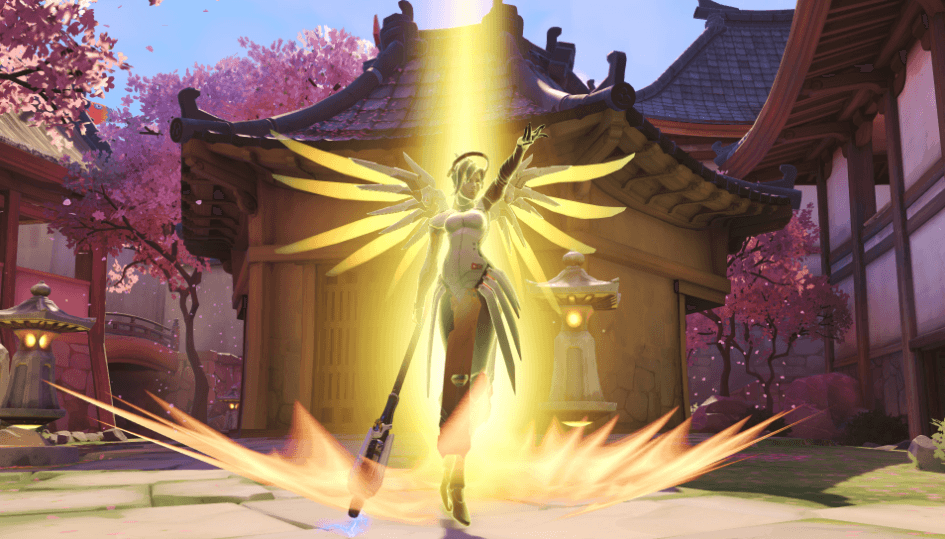
Mercy has a few character settings that make her a more effective hero. In your setting for Mercy, change Guardian Angel prefer beam target OFF. You can fly further than your beam can reach, and changing this setting allows you to top off a teammate’s health while flying across the map to another teammate. Change Guardian Angel toggle OFF because this can get you into big trouble if it’s on. Sometimes you fly towards a teammate who starts to get focused by the enemy team. You need to be able to let go of Guardian Angel so you do not fly all the way to where your teammate just died.
Second, change Beam Toggle ON so that you will always be connected to someone, whether healing or boosting. Turning this on will increase the amount of healing you do per game. For me, I averaged about 1,000 more healing per game.
Changing these settings helped both my healing done per game and my survivability.
Mercy is a useful healer to have on a team. Her healing and abilities make her a viable pick if you can play around her weaknesses. Being one of the most targeted characters in the game, staying in motion is more likely to save you than pulling out your pistol. Mercy has a simple tool kit, but try playing her without dying more that you Rez. She becomes a bit harder to play then.
Like our content? Support us by getting our merchandise in our shop