




Blogs
Show and Tell: A Guide About Communication

On every level of League of Legends, from Bronze to the LCS, communication makes and breaks placement matches and playoff dreams. Playing around your teammates and taking advantage of superior numbers, clearer vision, better focusing and an overall strategy can lead to victory even over seemingly more skilled opponents. I've always like to compare a team in League of Legends to a fist; there are 5 fingers on a hand and only combined they create the strength to throw a punch. One key part of working as a team is communication. Only by partaking in conversations with your allies you can ensure you're on the same page as them. There is plenty of meaningful information to be tracked and communicated in a single game of League of Legends and to ensure effective communication, one has to use the available tools and to designate a normalized way for the information to flow. Therefore, I will only talk about communication in a completely premade team.
Use the chat to keep track of important in-game information. There are a ton of important cooldowns and jungle timers in the game which need to be tracked. Knowing whether an enemy Marksman or Assassin has Flash can be a huge influence on potential plays by the Jungler or decision making in a teamfight. I know too many people who tend to just call a cooldown in Teamspeak without writing it down. I don’t want to discredit the memory some players may have, maybe there are Junglers out there who successfully remember several Flash timers while still flawlessly farming their jungle and controlling their champion. But I can certainly not do that. The most effective way to keep track of summoner cooldowns and jungle timers is to call them and then write them down in the chat. A short “Caitlyn Flash 8:32” is sufficient and provides every player in the team with the needed information and can always be checked again.
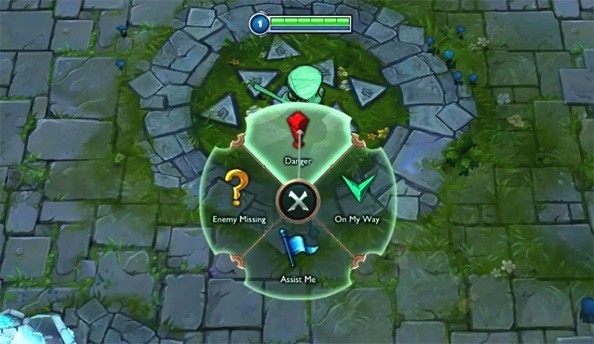 Smart Pings can be an effective tool to inform your teammates of your teleports, missing enemies or other important issues.
Call macro plays and make sure everyone knows what their part is in setting them up. This should probably be the Support or the Jungler’s job, but whoever it may be, one of your team has to lead the charge when it comes to macro plays. The best start to a macro play is to announce the goal you want to reach within the next minutes. For example: “We need to dive the bot lane outer turret”. Then you can start communicating the important information leading to the play. Where is the enemy Jungler? Do you have Teleport up? Does your enemy have it too? Is mid lane able to push the lane and roam before the opponent? Do we have sufficient vision of the enemy jungle? Are Teleport wards in place? All these are important bits of information and only by successfully communicating whatever knowledge you may have, can you ensure the play to be as safe and consistent as possible. Other important macro calls can be trinket changes and the usage of wards, sweepers and blue trinkets.
Call targets and important cooldowns in teamfights. Teamfights are a place of absolute chaos. With up to ten Champions taking part in fast paced combat, things can get messy very quickly. Communication can actually help a lot in creating clarity in this disorganized environment. We can get a nice idea of how this can or should sound like by listening to the “Mic Check” episodes Riot offers. One thing most teams tend to do is to call out the name of the champion that needs to be focused loud and as clearly as possible. Calling out the intended focus can help prevent tunnel vision. Of course, it can sometimes actually make it worse, so be careful with those calls. If you realise that your allies are tunnelling too hard, try to call them back. Again, communication is key in preventing tunnel vision. Another very important bit of information during a fight is the cooldown of huge damage or CC abilities. AD Carries and other squishy champions rely on being safe while dealing their damage. This means they have to keep their distance from an Orianna, Ahri or similar threats, as long as their Ultimates or other key abilities are up. Knowing that important abilities are on cooldown can allow a carry to position more aggressively, potentially leading to a higher damage output, maybe even on high priority targets. The cooldown of your own abilities are equally important, always tell your AD Carry when your Black Shield or Wild Growth is still up during a fight.
Listen to your team and their issues or opinions, but be able to call decisively when it’s needed. Also, always follow the decisive calls from your shotcaller. Discussing possible options and develop a strategy through several heads is definitely effective and leads to more differentiated approaches, but in clutch situations there needs to be one direction, one decision, one clear call. You cannot expect your team to follow your Nashor call if you formulate it as a question, already doubting your decision yourself. Be confident about your decision, call it and act as a unit. It’s better to follow a risky call as a unit, potentially losing a game, then not to follow a call, splitting off and losing 100% without knowing whether it could have worked out. Bad calls happen but only by decisively acting on them, you can actually realise their flaws and ultimately improve your shotcalling abilities by preventing those decisions in the future. It can help to have a designated “last voice” in your team. This player doesn’t need to make all the calls or to confirm every single one of them, but in situations where there are several different calls, the team then knows which call to follow without having to elaborate on the options first.
Avoid talking about individual mistakes during the game. When people make mistakes they most likely already know they did. Of course, repeating mistakes need to be addressed, but not during the game and with a friendly tone. When your top laner dies, he doesn’t need to be told to play more carefully, try to be positive instead and inform him of the accomplishments your Jungler created on the other side of the map. When the enemy Jungler is camping Top, ward that side of the map and either set up a counter play or a proactive play on the other side of the map to take advantage of the camp. Make sure that your teammates know their role inside the game and don’t lose hope. Players don’t improve over some minutes during a game and telling them to do so will not increase your chances of winning.
Communicating effectively with your team can win you games like crazy. I hope some of these advices help you to improve your in game communication abilities.
Are you into fantasy leagues? Then check out AlphaDraft and put together your allstar lineup!