






Blogs
Back to Basics: Understanding the Fundamental Elements to Winning in Solo Queue
quail
Tue 24th Mar 2015 - 9:43pm

Sometimes when struggling to climb the solo queue ladder, it’s easy to forget the simple things that help us win games. Instead we focus on specifics such as people getting caught or the disheartening top who fed in lane. In reality, dwelling on the skillshots you missed, isn’t going to help you win the next game. When people tilt and go on losing streaks, they forget some of the simple tricks to winning games. If you take a step back and remember some of these important factors that often go unexplained or unnoticed, you can help improve your results.
1. Individual games do not matter
A lot of the time solo queue can be stressful because we put so much emphasis on each game. Losing any amount of LP feels like a huge step backward. The truth, however, is that unless your skill level is significantly higher than your current elo, the grind is going to be more like taking 2 steps forward and one step back. Sometimes you may take many several steps backward at a time. What does matter, is some amount of progress. Even if you aren't currently gaining elo, as long as you feel like your personal play is improving, then you are on the right track.
Metaphorically, a single game is just a link on entire length of a chain. The chain of progress is made up of many links; some stronger, some kinked, some worn. A single link, or in this case a single game, doesn’t represent the full chain of events. Moving away from isolated thinking will help free your mind from getting dragged down by rough game patches.
Realistic Progress
2. Learn to adapt
No matter the elo, individuals have notable tendencies. Some players try to dodge skillshots by moving to the right, while others step forward. Often people ward and sweep the same places throughout the game. Other useful tendencies to take note of include:
- Junglers that continuously invade and counter jungle; ward entrances and catch them in the act.
- If a jungler solos dragon early, they are likely to attempt another solo mission on spawn; ward up, pick them off, take dragon for yourself.
- Supports that roam mid to gank; ward up river and punish them when they move to roam.
- Laners that push without warding; gank, gank, gank!
- Players that flank to initiate teamfights; find and pick them off to win the proceeding 4v5.
- Taking note of a players habits and adapting to them is a very useful skill, and in games that are close to even, it’ll help put you ahead.
Perhaps even more importantly, you need to learn to adapt to your own team. Often when a team loses a game in which they have a lead, it’s because the members are split on how to close out the game. Some people want to continuously work to catch out and pick off players by spending a lot of time in the enemy jungle. Others want everyone to group and siege down turrets and force teamfights at objectives. Both of these styles can be successful when executed correctly, however, in order to do so the entire team needs to be on the same page. Figuring out what works best for your situation and adapting to that playstyle will help you lead your team to close out games.
3. Ranked is a display of your personal skill
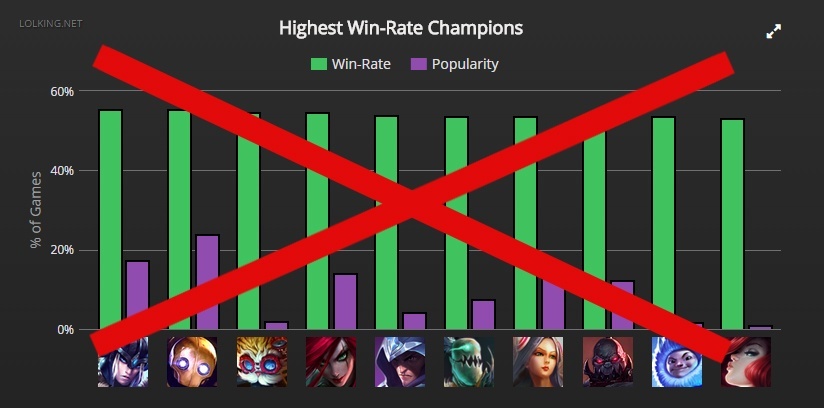
In episode 2 of TSM: Legends, Reginald said, “Picking champions is beyond what’s the best, it’s also about what the player is best at as well.” This sentiment is even more important for solo queue. The golden rule of solo queue is play what you know, not what is perceived as overpowered in the current meta. It doesn’t matter if a champion with a top 5 win rate is left unbanned, you will still find more success with a champion that you’ve played 100 times. Lack of knowledge about a champion isn’t balanced out by how strong that champion currently is. While it might make up for your mechanics, you’ll still have to concentrate on parts of playing that champion that would otherwise come naturally, thus inhibiting your ability to focus on playing the map and winning the game.
4. Understand your role
Part of every solo queue game is understanding what role is necessary for you to fulfill. When I speak of role, I'm not referring to what lane you play, rather I am talking about what type of part you play in your team’s victory. Too many people make the mistake of trying to carry every game on their own. Think of it like a theatrical play; though there are several actors who are all necessary in order for the entire production to come together, only some will hold the spotlight with others taking on supporting roles. If you go 0-3 in lane, the play isn’t over, you simply have to adjust to a supporting role that allows for other people on your team to carry. While streaming Voyboy sometimes says that your job is to be as weightless as possible. While this holds weight, there are always things you can do to help the team be successful.
Another way of thinking about it is that while it’s important to have threats on a team, it’s not necessary for everyone to be a damage threat. There are other, just as important, ways to impact the game such as buying wards/maintaining vision, getting tanky/using CC correctly, and pushing lanes/helping map control. There are plenty of strategic moves you can employ to help your team, even when behind. For example, a top laner who has died a couple times in lane can gank mid to help spread gold and increase map pressure. Additionally, having the top laner on the bottom side of the map opens up bottom river for the support to ward and sweep, setting up dragon control. The top laner will lose out on farm, subsequently decreasing his damage threat, but successfully take on an alternative role that still helps his team achieve victory.
5. Weigh the Pros and Cons
There are downsides and upsides to every decision that you make on the rift. While many situations call for instantaneous decision making, there are times when you have a moment to ponder your choices. The most common instance involves warding practices. On the surface, warding appears to be a simple act of do or don’t, however, it is actually a delicate process that requires spot-on decision making. The best supports understand timing when it comes to acquiring safe vision, when they won’t get get caught out because side lanes are pushing, and what places need to be warded given the team’s map movement to provide maximum efficiency, etc.
Another general example, is when you decide between grouping with your team and splitting off to farm a wave or jungle camp. Grouping will allow you to place specific map pressure that forces the enemy to react to your movements, however, you will lose out on farm and gold if it doesn’t successfully lead to an objective for the team. Farming on your own will increase your personal gold value but neglects proactivity in winning the game by taking objectives. Every time you decide to go somewhere on the map, you should consider the benefits and setbacks.
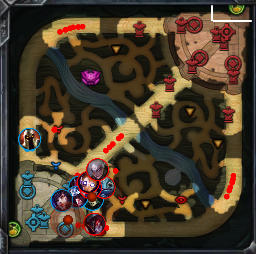
A lot of the points in this article are probably steps that you already utilize some or most of the time whether or not you realize it. However, recognizing and understand them will lead you to use them more often and more effiectively. Though there are many components to winning a solo queue game, making sure that you have the basics covered will help ensure that you aren’t losing winnable games.