






Blogs
Looking at the Numbers: How Knowledge translates to Damage


Game of Numbers
League of Legends is, first and foremost, a game of numbers as everything that occurs within the game is according to the numbers. This stresses the importance of those numbers and how we view them visually. We passively build a perception of what our damage is when we first head into lane or into the jungle. Some things in lane can strike us out as strange, for example when you do more damage than you had anticipated on an ability, as it turns out your enemy laner is not using defensive runes against the type of damage of your ability.
Something as simple as viewing your enemies stats in lane and viewing the damage on your own abilities can help you build a perception of how much damage you can do to your enemies. Our brains take some time for us to mentally correlate how much damage we can do over time with how much damage we are doing at the moment, this can make certain champions harder to play. Champions who do percent HP damage, percent of missing HP, or % of max HP damage do differing amounts to damage to different champions on the enemy team. Abilities that do reduced damage per hit such as Ahri's Fox Fire or increased damage such as Brand's Pillar of Flame can be difficult to guage.
Nothing to Lose
Many players have played the game without looking at the numbers and have gotten along fine, they win games and many players can be confident about when and how their favorite champions are strong. Looking at the numbers of the game gives us knowledge in a more direct way than the receptive knowledge we receive from casting an ability. When we use an ability, it does damage, we see that damage with our eyes, and we take what we see from that one spell and try to remember how much HP it visually took from our enemies HP bars.
This can be a slow process and can take a few trades of abilities before you have conceptualized when and how you can kill your enemy. When we take a look at the numbers of our abilities, add them up, and compare that total to the enemy champions maximum health, we can conclude how many skill rotations it may take to kill the enemy champion. This decreases the amount of trades we need to see with our eyes and may even tell us when we can kill our enemies before they realize it.
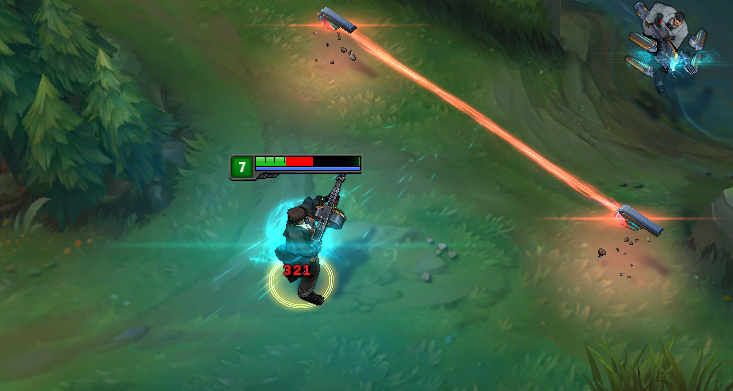
Many times we don't have the luxury of taking in the numbers, here we see that Graves takes 321 damage from a shockblast. Being at around half heath before the shockblast, without seeing the number shown above, we can guess that it dealt about as much damage as Graves has in remaining health.
The More You Know
There is an overwhelming amount of information in each game of League of Legends, while much of the information is relevant is some way, to sort through it all we have to start with what is most relevant to us. A good starting point is:
I. Our champion’s numbers
i. Damage on abilities (Base + ratio)
ii. Health and Mana
iii. Summoner spells
Looking at our own numbers, even just scrolling over our abilities to add the base and additional damage, can tell us a lot about what we can expect to get out of our items. Even glancing at the chunck of health missing after being hit by Jayce’s shockblast can help us more accurately conceptualize how strong the champion is from the damage we take.
After buying a BF Sword we observe the damage our ultimate does. Adding up to 366 damage, we can assume that we will deal around 300 damage to a target that isn't building too much armor.
Here we see that Collateral Damage dealt close to 300 damage. If we were the victim we could guess that if Graves still has the same items when we next encounter him, he could deal roughly 500 damage with his Buckshot and Collateral Damage. This gives us a measurment of when our HP is within his kill range.
Just by scrolling over the enemy champion's defenses we can see how much armor and MR they are using. Seeing that they have no armor or MR usually means they will be taking a lot of damage from those sources. Looking at runes can prompt us to take advantage of their lack of defensive stats.
I. Our enemy’s numbers
i. Runes
-We take a look at the runes as many rune set ups have the most impact in the early game. Being aware of our enemy’s armor, health, and magic resist can nudge us toward making that killing blow or help us understand which direction to take the match up.
ii. Base damage and Ratios of abilities
-While in the loading screen we can take a quick look at our enemy laners base damages and ratios, from this we can build a rough estimate of how much damage they will be doing to us.
iii.Health and Mana
-After adding up how much damage our abilities do we can compare it to how much health our enemy has. Through this comparison we can figure out a rough estimate of when we should use our abilities and how much kill potential we have.
iv. Items
-From what our opponent builds we can also create a rough estimate of how much damage they will deal and where that damage will be coming from. If Yasuo has a Blasting Wand, you can play with more confidence as opposed to seeing that Yasuo build a Statikk Shiv. We can apply the same idea to the bottom lane, if one Marksman builds a Vampiric scepter and another buys a pickaxe, we can evaluate where each item’s strengths are and play to them quicker.
v. Summoner Spells
-Summoner spells can be the last thing we can consider as they take the longest to come up between fights. Knowing when to hold onto an abilitybecause you know your enemy has a summoner spell can make a difference. Although knowing if a summoner spell is up can allow one to followthrough with confidence or hang back and play it safe, thus sometimes summoner spells need to be the first thing we take into consideration.
Conclusion
From looking at the numbers of our own champion, the enemy, and their items we can construct a visual sense of the damage that the abilities of each champion will do. The more information players have at their disposal, the better the choices they can make. Informational awareness sharpens the accuracy of the decisions players will make, hence any information regarding our champions or the enemy champions can be used to refine our visual interpretation of the damage each champion will exchange. Being aware of the numerical advantages we possess before our first ability hits our enemies can give a player a headstart in a fight.