






Blogs
Earn Your Degree in Creep Wave Management
Pseudokudo
Sat 27th Dec 2014 - 3:32pm
Introduction
Creep wave control is often an overlooked aspect of League of Legends that even players in Diamond have not fully wrapped their heads around. In a competitive environment, teams are frequently seen manipulating the wave for a variety of uses such as denying gold and experience from the enemy laner to creating what Christopher "MonteCristo" Mykles coined "The Sixth Man," a strategy developed by CJ Entus Blaze, in which massive waves would snowball in the sidelanes and pressure towers by themselves. Learning how to properly manage the wave will not only improve your laning phase but will allow you to have a better understanding of how creep waves function and be able to identify whether they are working towards your advantage or disadvantage throughout the game.
Basic overviews of how creep waves work
1. If there are equal amounts of creeps on blue side of the lane, it will push towards purple side of the lane, or vice versa. Since it takes less time for reinforcements to arrive, they will outnumber and also outdamage the opposing creep wave (think home field advantage).
2. Focusing the caster creeps early in the game will cause the wave to be frozen close to the enemy turret which will result in overextension and vulnerability to an early level two gank if the enemy jungler starting in the top side recognizes this. However, if you plan on harassing the enemy laner with autoattacks, killing a few of the caster minions will ensure that you will come out ahead in the damage trade. Remember that abilities do not aggro the creeps, so take advantage of this as well.
3. Assuming an absence in lane, the most ideal time to recall is when your wave is pushed to the turret since the enemy laner loses out on potential gold and experience. If your wave was killed before the incoming enemy wave collides with it, then both waves will reset in the middle of the lane. If it is not possible to safely push the wave to the turret due to lack or vision or jungle threat, make sure the wave is slowly pushing towards your turret meaning that the enemy wave is up at least a minion advantage over yours. Time your recall before a cannon wave so that you will not lose out on the valuable cannon creep.
4. In an event where you have no wave and want to avoid a huge enemy wave from reaching your turret, standing just outside the turret range will cause the wave to stop and aggro onto you (done by supports to preserve farm for arriving ADC's). Until your incoming creep wave arrives to take the aggro for you, you will take noticeable damage so do this only if you know the enemy laner cannot threaten you. It also opens up opportunities to trim down the wave and freeze the lane and ultimately deny potential gold and expererience from the enemy laner.
5. In general, clearing an entire wave and then clearing up to three caster minions in the next wave will guarantee that the wave will push on its own. This works especially well if there is a long lane where there are dead turrets and/or champions that cannot interrupt the development of the wave. It is extremely useful in setting up lane pressure and then grouping up with your team elsewhere on the map. By forcing one enemy to show on the minimap to react to the massive wave that is dealing significant damage to a turret, this allows your team more freedom to make plays and pressure objectives on other parts of the map since you have the numbers advantage in team fighting in a 5v4.
Lane Openings
Here are some ways you can influence the early laning phase while maintaining a certain degree of control.
Pulling the wave
Pulling the wave offers the ablity to establish wave control and can be done with every champion. By having the wave pushed or "pulled" toward your side, parameters are able to be kept under control and randomness can be avoided. As a result, there are opportunities to continute to have the wave being pushed towards your side, reset in the middle, or pushed towards the turret. This method of wave control provides the luxury of having flexible options to be able to adapt to various situations.
The initial three melee creeps must become aggro'd before it collides with your wave. This can be done by arriving early in lane and walking towards the melee creeps and walking back toward your wave. It is extremely important that no damage is taken from the three melee creeps otherwise they will not properly switch aggro to focus down your initial melee creep which is how the pushing towards your turret develops. Remember to trim down the wave to a manageable amount if it starts to become hectic.
Shoving the wave
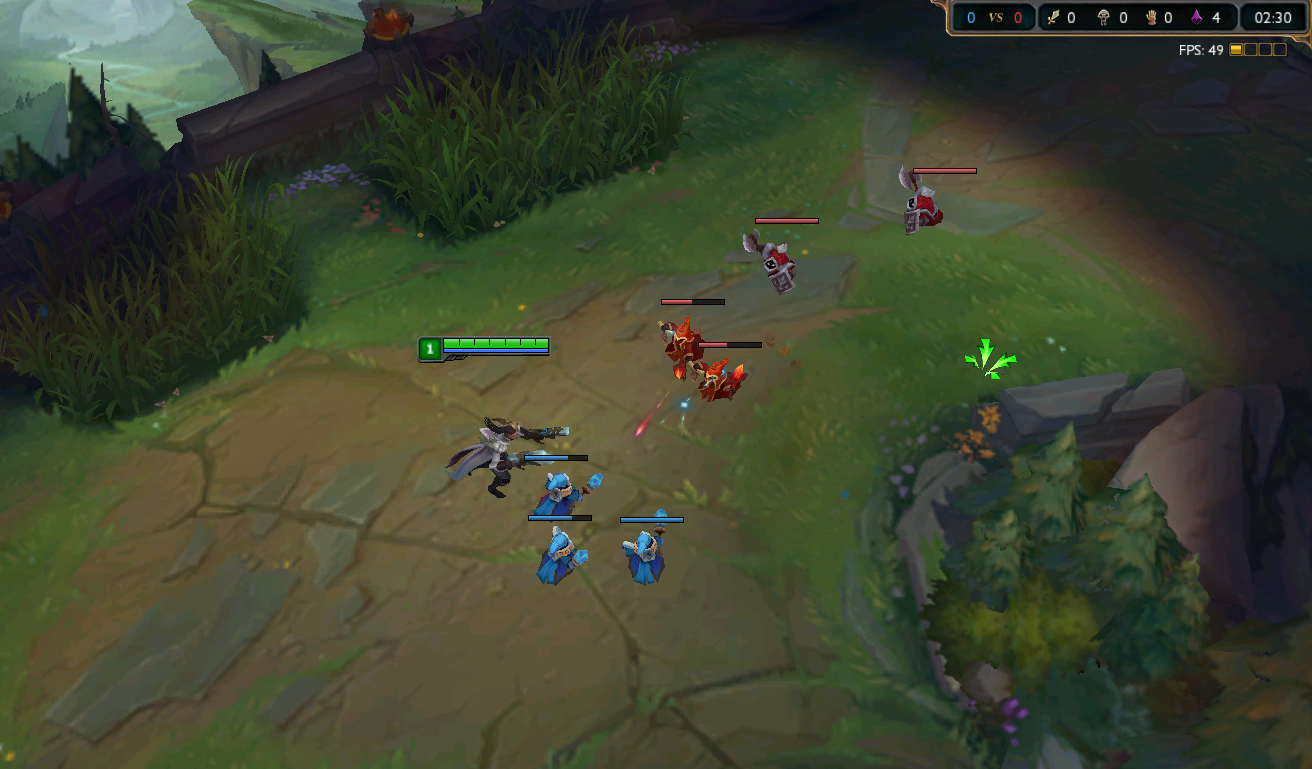
Shoving a wave works well with champions with good initial wave clear such as Lissandra or Lucian as it requires the first two waves to be cleared fairly quickly. It allows for an aggressive playstyle with an early and advantageous level two. Not only does it punish enemy champions who cannot farm well under turret in the early levels, it opens up a window of opportunity to ward the river brush or the tri-bush in order gain vision of unsuspecting ganks. You will be pleasantly surprised to discover that in the meantime, no creeps were missed out on and that the wave is beginning to push towards your side.
It is important to note that wave clearing the first wave is not recommended. The key is to hit the creep waves as often as possible but be able to leave some alive as the second wave arrives to join the survivors. During this point, posture for a level two advantage as well as focusing on wave clearing the entire remaining creep waves so your creep wave will push towards the turret. Having some creeps from the first wave remain alive until the second wave comes to reinforce them is extremely crucial because without the creeps from the first wave, your first wave might already be taking tower shots or has met up with the second enemy wave awkwardly right outside of turret range. Being this overextended is dangerous because it could prompt the enemy jungler to come gank at level two if they started in the top side jungle.
Understanding "The Sixth Man"
Can also be referred to as slow pushing the lane or snowballing the wave.
What exactly is "The Sixth Man" and where did it come from?
During game 2 of CJ Entus Frost versus CJ Entus Blaze in the 2013 OGN Champions Spring Semi Final, both top laners would have their turrets destroyed very early due to 2v1 lane swaps. However, Flame would allow the wave to push past his destroyed turret and onto his blue side of the map where he freezes the lane and carefully last hits the creeps at the last possible second. By farming safely on his blue side of the map, Flame not only develops a massive wave to push the turret, but discourages Shy to come and grab farm because it would require him to be overextended and leaving him vulnerable to a gank. As a result, Shy misses out on significant gold and experience and forces him to make plays on other parts of the map until he can arrive to lane to deal with the massive wave or "The Sixth Man" pounding on the turret.
When should I do this?
When losing your turret early either to your lane opponent or even the ocasional 2v1 lane swap in solo queue, it is appropriate to do this if you know your lane opponent cannot create a huge impact elsewhere on the map and can trust that your teammates can defend the other outer turrets and effectively disengage teamfights until you develop your wave pressure and leave to group up with your team.
What are the advantages?
Safely farming within your own territory will force the enemy laner to either risk getting ganked by overextending to farm or attempt to be useful on other parts of the map. Champions like Ryze or Akali who thrive on getting past the early game with abundant and safe farming will be ahead in gold and experience over the enemy laner while being able to create lane pressure with massive waves. This can also be used to break a stalemate in the mid lane by forcing an enemy to show and respond to your massive wave pressuring by themselves which gives your team favorable opportunities to 5v4 team fight over objectives and put pressure on other parts of the map.
What are the disadvantages?
Coordinated ganks or assassins such as Zed can safely travel deep into your side with proper vision control to effectively prevent the opportunity to farm, disrupt the development of a massive wave to pressure lane, and end your freeze. It can be potentially punishing and costly to your team's success if nobody is on the same page and if you do not use proper judgement to decide whether to continue with this strategy or to leave and help your team elsewhere.
Conclusion
Creep waves are not just mere turret damage absorbers or a source of gold income. Understanding how to manipulate creep waves offer the necessary tools to respond to various situations such as predicting the direction the wave will push during laning phase or denying resources from your opposition. Learning how to execute advanced strategies such "The Sixth Man" can sometimes give you a favorable edge in creating a creep wave threat that resembles having a sixth member on your team that does damage for you. According to Sun Tzu in The Art of War, “supreme excellence consists of breaking the enemy's resistance without fighting,” which can be seen through taking advantage of creep waves so that they indirectly contribute to your success.