






Blogs
Learn how to control creep waves

ThousandEyes
Wed 19th Nov 2014 - 5:42pm
One of the finer points of League of Legends is controlling the endless waves of creeps that mass themselves out of the nexus. In fact, I’d argue that it’s one of the most important things to pick up once you start getting into the details of the game. Creeps do a lot in the game. They give gold on death, they give shelter when pushing into towers, they block skillshots if used correctly. They are an extremely underappreciated part of League, and understanding how to manipulate them is core for improving your play.
Minions spawn at 1:30 and spawn every 30 seconds. They get stronger in 2 minute intervals, and do extra damage to towers and reduced damage to champions. Once they spawn they follow down their lane that they’ve spawned in and attack the first enemy that they come up against. Once you break them down they have really interesting priorities in what they attack.
They actually are programmed to respond to calls for help. Once they receive a call, they evaluate whether that call is of a higher priority than what they are currently responding to.
The priority list goes as follows:
- Call from ally champion being attacked by enemy champion
- Call from ally champion being attacked by enemy minion
- Call from ally minion being attacked by enemy minion
- Call from ally minion being attacked by enemy tower
- Call from ally minion being attacked by enemy champion
- Closest enemy minion
- Closest enemy champion
The biggest thing to note from here, although there’s a lot of interesting things going on here, is this. Above all else, if you attack an enemy champion in range of their minions they will always focus on to you. Which means if you enter an enemies' domain of minions and start a fight, you’re engaging in a fight with them and their minions. This is a huge deal in the early levels when you’re barely stronger than those minions.
Next, is that if you’re being engaged by enemy minions, your minions will come to your aid. This won’t happen though if you’re too far away. Remember you have to be within “call” range of your minions for them to respond.
I’m going to skip number 3 since it’s pretty basic. 4 and 5 are interesting to me purely because of the order. Basically, what is being said here, is that minions will target towers attacking their friends over champions attacking their friends. It makes sense when you think about trying to farm under tower, but can be interesting when you think of tower dives and how the aggro can work out there.
Another thing that may be important to remember is that, when attacking a tower, having minions around lowers a towers defenses. This means you really want to have minions around when attacking a tower. Not only for the act of tanking the towers shots, but for making it easier to kill as well.
Strategy
So now that we effectively know how a minion will think, what can we do with this knowledge? Well there’s a whole lot! Minion manipulation can be a great way to slowly swing a game in your favor. There’s a bunch of strategies ranging from split pushing, to slow pushing, to freezing. A lot of people are aware of these strategies, but if you tell them to do it in game, they’re going to look at you with a blank stare. So why don’t we go into the the how and when?
Split Pushing
First let’s look at split pushing. For those not aware (and bless your souls if you aren’t), split pushing is when you have one team member push a lane by themselves while the other members of the team hold a siege off from the other team. The goal here is one of two outcomes.
The split pusher is able to take important objectives while the rest of the team successfully holds their base.
The enemy team has to send a person, or best case people, to handle the person split pushing
Luckily this strategy doesn’t require a lot of complex minion manipulation, you just push waves as fast as you can. This strategy can be controversial in a solo queue environment since you’re basically putting one person on the team as a threat and you have to coordinate with each other from a distance. The risk can be very rewarding though because the enemy team has a very hard decision to make.
A split pusher usually has a few of the following traits:
- Good dueling power
- Teleport as a summoner
- Builds AD or Lich Bane
- Has a way to escape / mobility
Not all of these are necessary, but the more you have the more effective you can be at split pushing. A good split pusher will make the enemy team go through what a lot of people call “The Impossible Decision”.
“The Impossible Decision” is trying to choose whether to send someone or people back to handle the split push (or pushing wave) or trying to engage in a fight that may go poorly. This is a huge game mechanic that plays a part in almost all kinds of minion manipulation and is something that should be kept in mind for all of these strategies.
Let’s look at a specific example that would encompass all of these traits for split pushing to explain why they’re important.
Tryndamere is the textbook split pusher, and if we assume he’s running teleport (I realize this is not usually the case) he would have each of the traits we covered. He can duel almost anyone in a one vs one matchup. He has more single target damage than most champions, but he also has some inherent tankiness in his ult. Add an escape/mobility in his spin and you’ve got someone who requires more than one person to handle. A tank won’t damage him enough alone, and a squishy damage dealer will get out traded and jumped on.
What split pushing lacks in minion control it makes up for in team coordination, which is why it doesn’t always work out. The rest of the team has to be ok with letting one person try and basically win the game by themselves. It takes a lot of trust and can be the source of some fighting internally. If you’re running teleport you have to be aware of any fights that break out and when to use teleport effectively. It’s a delicate situation on both sides so it needs to be played well.
Freezing a Lane
Freezing a lane is a bit more complicated in terms of what needs to be done, but it can be a great way to stall out a game and catch up in gold. Freezing can be effective if ahead or behind as it basically makes the enemy try and use their time effectively in another way. Before we go any further though I want to fully explain what freezing a lane is.
Freezing a lane is when you let the minions in your lane either stay where they are or push towards you, rather than just attacking minions at random and making the wave push towards the enemy. It takes a bit of patience and a careful eye to pull this off. Sometimes it isn’t even possible.
You can freeze if you’re ahead or behind, it accomplishes different things on either side. If you’re ahead and freeze you’re putting an already behind opponent in a position where they can’t even try and claw back up. If you’re behind, freezing lets you safely farm and force the opponent to move far up and risk dying if they want farm.
If your goal is to freeze a lane, first thing you need to take into account is the wave of minions. How many minions from your side are there vs. how many they have. If you have more fighting where the lane is currently sitting then you’re not going to be able to freeze the lane, it’s already pushing the other direction and any kind of interaction from you is going to make it push faster.
However, if the number is even or in favor of the enemy minions, you can usually get the wave to stay where it is for a decent amount of time. It can take a little bit of effort though. If the wave is in the enemy’s favor all you have to do to freeze it is wait for the minions to get as low as possible before you take the kill. This will keep the lane from moving and if done correctly will still keep the lane pushing towards you.
Why is this important? If the enemy wants to try and get exp and gold from that lane, they have to move very far up the lane and risk getting picked off.
If the lane is even or about to break even you’ll have to try and “pull” the wave and get the minion aggro to work for you.
Remember how we talked about how minions prioritize targets? Well, some of that comes into play here. Left alone minions will walk into lane and clump up in the middle, like so.
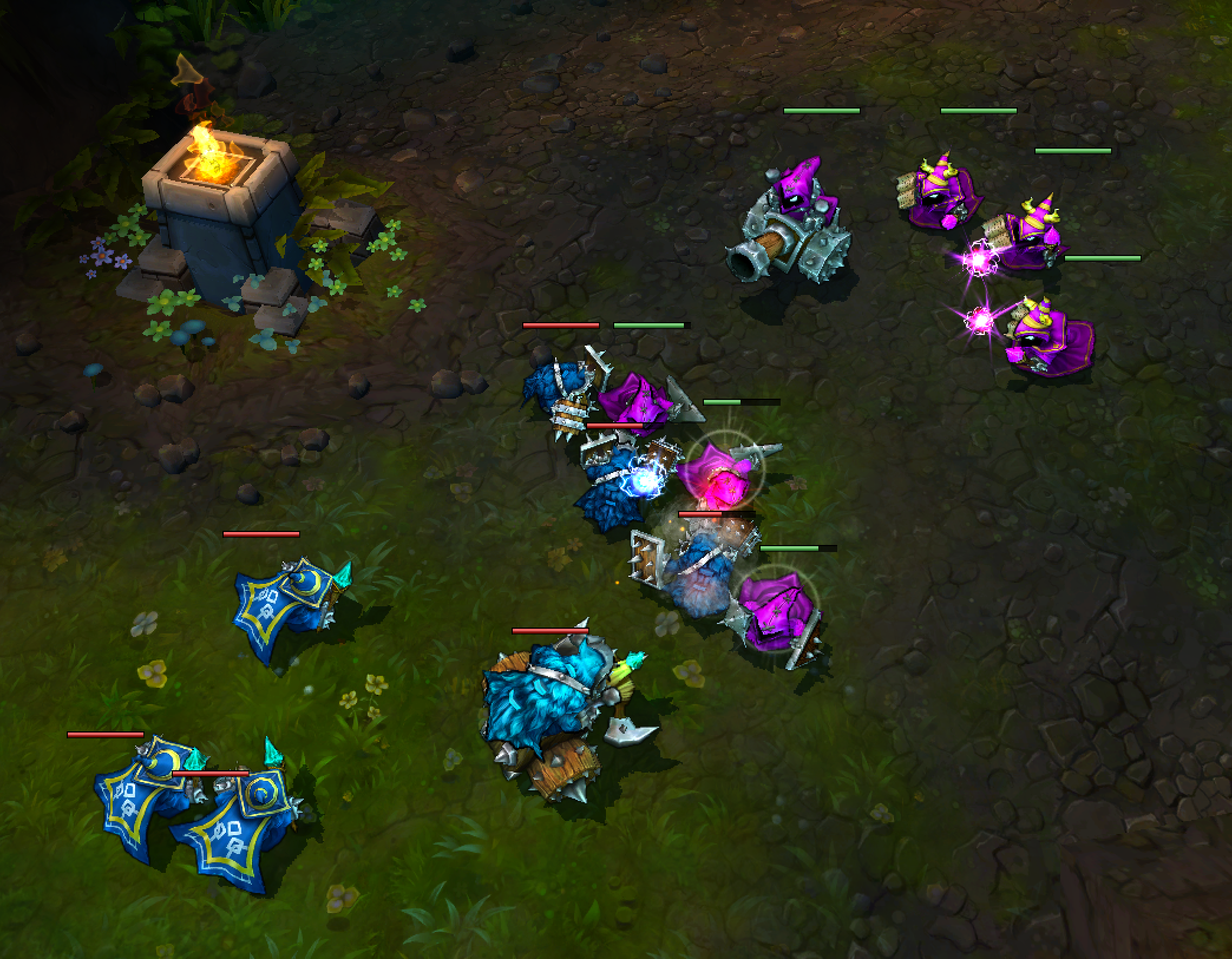
Notice how they all target different creeps? This is important, it’s what keeps the wave even. In a perfect world the minions would kill each other at exactly the same time. However, if another variable comes into play this can be messed with a little.
Minions will target the first thing that comes into their line of sight, so if you walk in front of the enemy wave they’ll see and target you first. If you pull the wave over to the side like shown below, you’ll force the first 3 enemy minions to all focus the first minion in your wave.
In this example the wave will push towards the RED side.
They’ll take this minion out and then after that it’s a number advantage for the enemy wave, meaning it will push towards you. It’s a nice trick to manipulate creeps and get the game to work for you.
Slow Pushing
Slow pushing is probably one of the most complicated things to do in League and it’s one of the finer points of minion control. Slow pushing requires a lot of set up to do, you’ll set the lane up to push slowly by itself and, if done correctly, will create those large creep waves you see pushing into a tower every now and again.
Setting up a slow push is great because you can basically have a free split push for your team. Minion waves can demolish a tower in the late game and having this done while you’re off contesting other objectives is a great thing to have for your team.
The best use of this would be setting up bottom lane to push while your team contests Baron. This makes the enemy choose between their base security and Baron buff/gold. It’s another “Impossible Decision”.
The big question is how do you do this? It’s actually pretty simple in theory, just takes a bit of careful auto attacks. The goal here is to have the lane push, but not too fast as you want the wave to gather in numbers before they actually begin moving.
So, if you take out the back three caster minions in a wave, you’ll generally set the wave up to slowly push. Those caster minions are a lot more damaging than the melee minions, who are more tanky, so taking them out means that the enemy wave still has tank, but no damage. It’ll whittle down slowly as your wave builds up and pushes. Eventually, your wave will be large and start moving with some force.
This isn’t very useful alone, but if you’re creating big distractions elsewhere on the map it makes the enemy choose between them. It’s really important that you try and make something that the enemy has to react to elsewhere. If you don’t you’re just giving the enemy a huge wave to go and farm later on.
Wrapping it all up
Minion control is a huge part of the game that not a lot of people put a lot of thought into. Controlling waves will give you an advantage that most don’t recognize as something that you can play a part in. You can split push, freeze, or slow push, and use the map and AI in the game to your advantage.
There’s even a few other ways to manipulate creeps too. You just have to strategize and understand what you’re doing and why you’re doing it.