






Blogs
The Beginner's Guide to Bottom Laning Phase as Support
THEDoughBOII
Mon 3rd Nov 2014 - 8:12pm

This is the second portion of a three part guide to the bottom lane for beginners. In this section, the role of support will be discussed. This article will not be as lengthy as the first, as the ideas of supporting at a beginner level do not need to be discussed as deeply as that of the ADC.
Goals:
While you are in lane, you have a couple of key goals you want to accomplish:
1. Protect your ADC – in the event that your opponents try to kill your ADC, it is up to you to protect them as best you can. Whether that be through using exhaust, using abilities, or placing yourself in the line of fire, survival of your ADC is vital to your lane’s success.
2. Feed your ADC – While you want to protect your ADC, you also want to be capitalizing on your enemies’ mistakes. If their ADC poorly positions, goes in too deep, or leaves themselves open to free harass, you want to make sure you’re taking every single advantage you can to help your ADC snowball.
3. Vision Control – As a support (especially in low elo) they are held responsible for vision control in the laning phase as well as throughout the game. Making sure you are safely warded while denying the enemy vision is key to winning your lane.
Support Types:
Support is a much more diverse role than the ADC. All ADCs are meant to be high damage carries that fulfill the same purpose. On the other hand, different support champions fill different functions in the scope of their lane as well as their team. There are three main types of support, which are discussed here:
1. Hard Engage Supports (ex. Leona, Alistar, Thresh) – These champions will possess a hefty amount of crowd control which helps them to jump onto the enemy and stay there so their ADC can safely deal damage. In addition, after laning phase these champions make great team fighters for their ability to lock down one or multiple members of the other team.
2. Poke/Disengage Supports (ex. Lulu, Janna) – These supports will be able to trade freely with their enemies, slowly driving their health bars down until they can either force them out of lane or kill them. Due to the often squishy nature of these supports, they typically possess strong disengage abilities to be able to survive an engage from a hard engaging support.
3. Sustain Supports (ex. Nami, Sona) – These supports are able to heal their ADC up from being dealt damage so that they can stay in the lane as long as possible. Again, these supports are usually squishy so they are able to peel for themselves to survive engages.
Based on the support you choose to play, your function in the lane will be vastly different. Also, it is important to note that some of these supports can serve multiple functions that were listed here (ex. Sona can poke/heal, Alistar can hard engage/heal).
The Race for Level 2
Oftentimes you will hear people talk about how level 2 is one of the most important points in bot lane. This is absolutely true, and the reason for it is that supports will typically have enough kill pressure with two abilities to either force summoner spells or kill their opponents if they themselves do not have level 2. Beating your opponent to level 2 gives you a huge advantage, however it does not take you out of the game if you can’t beat them. A way that you as a support can help reach level 2 before your enemy does is for you to help push the lane with your ADC.
You can autoattack the minion wave along with your ADC so long as you leave the minions with enough health that your ADC can last hit them to gain the money from the kill. If your enemy does manage to get level 2 before you, it is absolutely essential that you back off. You and your ADC need to far enough away from the enemy so that you can’t be the target of an engage, while at the same time still being able to farm/gain experience (if possible). Sometimes you may have to wait for them to push the lane to your tower in order to get the wave back into favorable position; however your safety should be placed as your utmost priority.
Positioning
Oftentimes as a support you will need to position yourself in such a way that you can protect your ADC in the event of an engage. If you can also position yourself in such a way that you can engage on the enemy in the event of a misstep, it’s a huge plus.
In this example, I have positioned myself in such a way that if Lucian were to engage onto Miss Fortune, I could easily come and protect her. Where you position in order to help your support can change drastically depending on the support you play. To know where you should be, just keep in mind what the ranges on all of your abilities are. If you know that most if not all of your abilities can be used to help your ADC in the event of an engage, then you are most likely in a good spot.
Vision Control
As was stated earlier, the job of controlling vision is left almost entirely to the support in lower skill levels. As a result, it is absolutely essential that you have both a Sightstone and a Sweeping Lens on any support that you plan to play. You must be warding such that you and your ADC are safe from any impending ganks. In addition, if you believe that you can safely plant deep wards in the enemy team’s jungle, then by all means you should do it. Deep vision can allow you and your teammates to better coordinate taking objectives, jungle pathing, and team fights depending on how well you do it. Here a couple of places where you could be placing deep wards to help your team:
In addition to these spots, it is important to keep in mind that there are areas in bottom lane that you need to keep warded as much as possible. In my previous guide discussing ADC, there was a helpful image showing heavily contested areas of vision control for bottom lane. The link to the previous article can be found here http://team-dignitas.net/articles/blogs/League-of-Legends/5966/The-Beginners-Guide-to-Bottom-Laning-Phase-as-ADC. This can help you plan where to ward to prevent ganks.
Peeling
A vital function to any support is that of peeling. Peeling is essentially using your abilities and attacks in order to pull the enemy off of your ADC, allowing them to safely fight without taking damage. How a certain champion peels depends on their kit, however the general idea stays the same. For example, Nami can use your ultimate and bubble to knock up champions on top of her ADC so that they have time to get away.
Thresh can use his hook, his flay, and his box in order to prevent the enemy from jumping onto his ADC. To peel well, you want to stay close enough to your ADC so that your abilities can actually help them get away. For example, a Thresh does not want to be far away from their ADC, otherwise how are they going to be able to hook/flay enemies off of their ADC if they are engaged upon? Similar to the ADC position, being able to properly position yourself to help you ADC whenever possible is key to being a good support.
Harassing in Lane
The job of harassing the enemy in lane is not only the ADC’s job, but the support can also deal damage to the enemy if they leave themselves open to it. It is important to keep in mind that you must harass such that you can protect your ADC in the event of an engage from the enemy team. Using abilities and basic attacks here both will dwindle the opponents’ health bars and either force them to recall to heal up or can sometimes result in a successful engage on your part to grab some kills. Also, keep in mind that you need to keep yourself safe; you can’t leave yourself open to an engage and leave your ADC helpless while your death timer ticks.
Runes:
An example rune page for a support may look something like what can be found in my own rune pages.
I run armor marks, health seals, MR glyphs and armor Quintessences on all of my supports. The reason I do this is because I like having the additional tankiness in lane in order to stay there longer. Some like to use attack damage marks so that the damage on their autoattacks can be increased, some like to use AP Quints if they want to amplify the damage on their abilities somewhat. Again, there is a lot of customizability to what runes you can run on a support. You can use my rune page as a baseline, or you can look to what the professional League players are currently running on your favorite support champion.
Masteries:
Again, to provide a baseline for what can be used on support masteries, you can view my own set of masteries here.
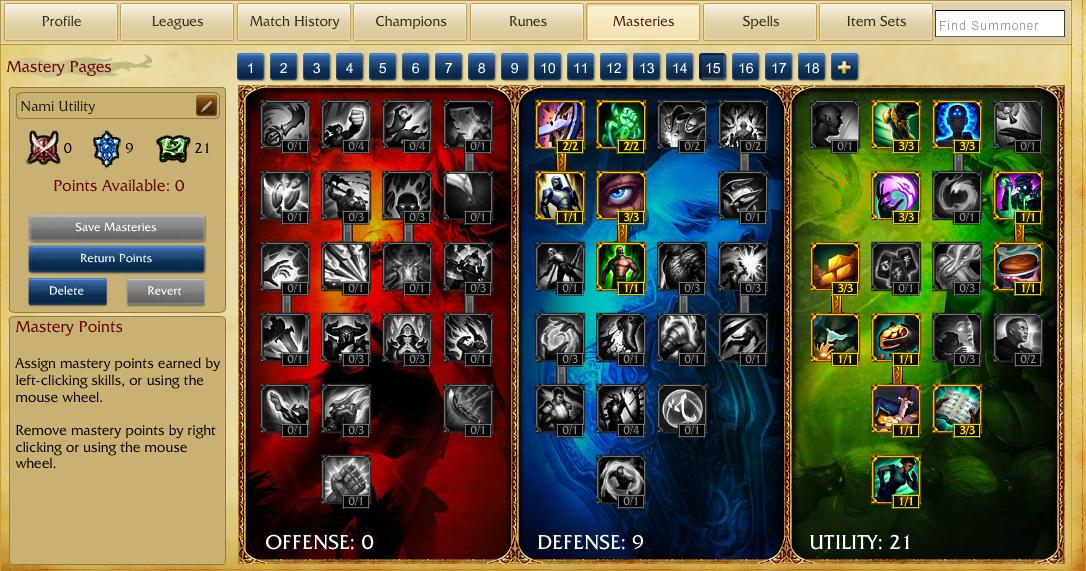
I myself run three different support mastery pages. The first is for tanky supports such as Leona, Thresh, and Alistar. I have another mastery page for spellcasting based supports such as Lulu, Morgana, and Sona. Finally, I have one final mastery page specifically for my favorite support, Nami. These are definitely places where you can start for your mastery pages, but again look to the pros if you want to see what they are running on your champion of interest.
Wrap-Up:
The role of support was discussed in this guide. This included important mechanics such as peeling and harassing, and other global aspects of the game such as vision control around the map. In the final part of my three part guide to the bottom lane, I will discuss bottom lane matchups and how some can in fact hold advantages over others.