






Blogs
An explanation of the Elo system

Whilst there are many articles that help you gain Elo, there seems to be a bit of confusion as to what Elo is and how the Elo system functions. Instead of using KDA or GPM for matchmaking, the Elo system functions purely based on a player’s past performance in terms of wins and losses.
The Elo ranking system, developed by Arpad Elo, is a method of calculating the relative skill level of a player. Although the system was originally designed for chess, it has since been adapted to many computer games (including league of legends). The reason for implementing such a system in league of legends is to find players of similar skill level when searching for a match and to provide incentive for players to become better at the game. Assuming that a player’s performance from game to game fluctuates at a normal distribution, the Elo of a player is calculated from the mean of that distribution. If both your Elo and the enemy teams Elo is known, one can calculate the chance of winning a game based on the cumulative results of prior performance.
The general formula for an expected victory is based on using 2 variables, the player’s Elo and the average Elo of the enemy team:
The expected victory outcome (ExA), therefore, can be determined by the following formula:
This is based on the assumption that a player with an additional 400 Elo over another player (or team, for that matter) will be 10 times more likely to win a game (as is the case in chess, although it is most likely to be the same in League of Legends). The value produced will be from 0-1, which allows for a percentage likelihood of winning the game to be produced. Below is a table of several Elo differences and the percentage chance of winning the game:
| Elo difference | Expected chance of winning the game |
| 0 | 50% |
| 70 | 60% |
| 140 | 69% |
| 210 | 77% |
| 280 | 83% |
| 350 | 88% |
| 420 | 92% |
| 490 | 94% |
| 560 | 96% |
| 630 | 97% |
If the player wins the game, their Elo change is as follows:
If the player loses the game, their Elo change is as follows:
Where k is a variable that changes depending on how many games have been played. A higher k value is assigned to newer players, as a way for a player to reach their skill level quicker. This value decays as you play more games, which means that changing your Elo once you have played many games is much slower. It is estimated that an initial k value of 60 is used which then levels out to 25 over a few games.
After each game, the outcome of the game changes a player’s Elo by shifting the mean of the player’s skill distribution either positively or negatively.
In league of legends, a league system is used to hide the actual Elo of a player (though raw Elo used to be displayed before the league system was implemented). This league system operates from Bronze tier through to Challenger tier, as you are likely to know. Each tier has 5 divisions, which goes from I>II>III>IV>V. Each division is to be estimated at approximately 70 Elo intervals. Each division is further divided up into League points, from 0-100. Therefore, 1 Elo is to be considered worth about 1.4LP.
The following is a snapshot of Elo distribution on the North American server as of 10/7/14:
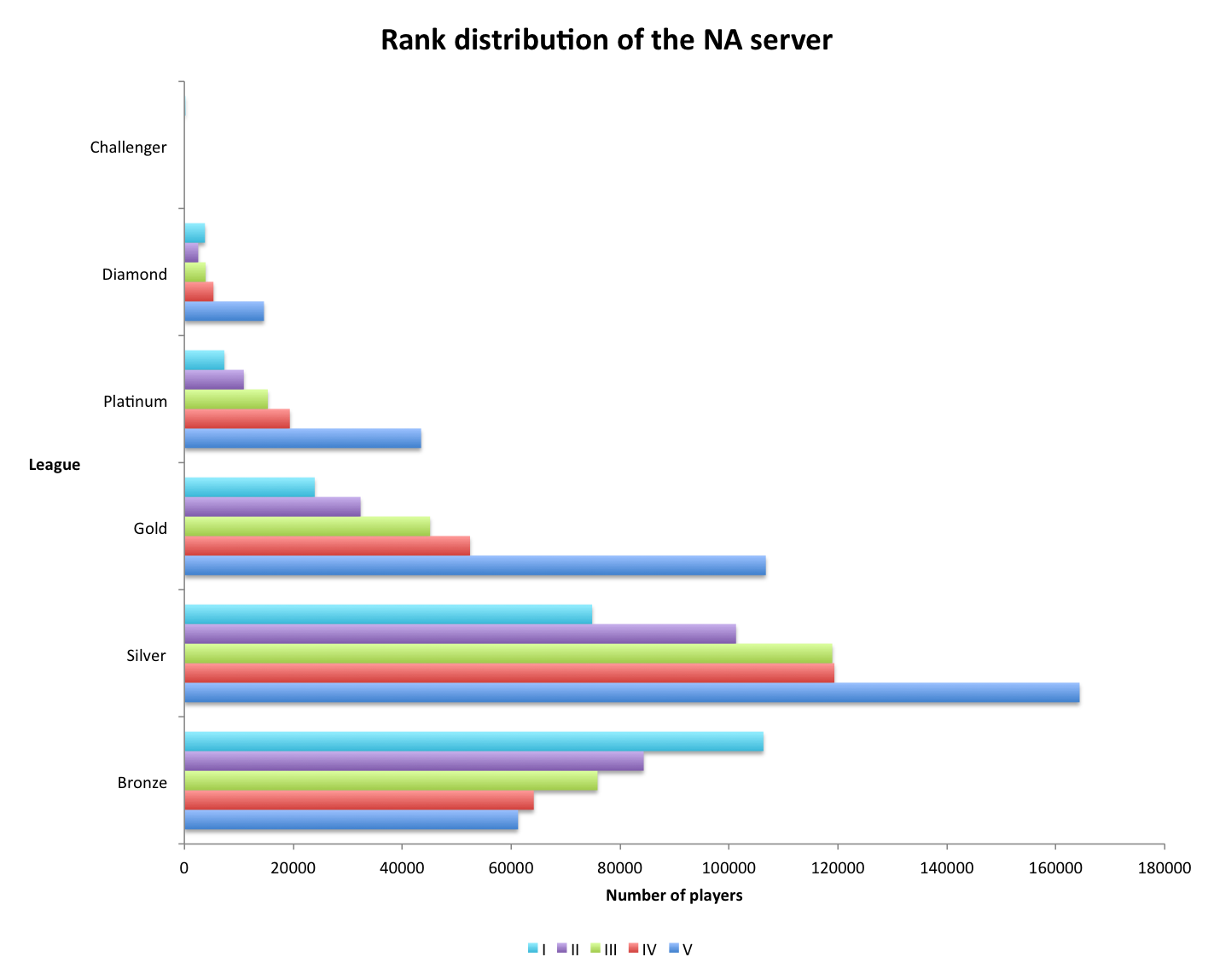
Note that a disproportionate amount of players are placed in the 5th division of a tier as it is difficult for a player to drop below that without becoming inactive for an extended period of time. Because it is difficult to drop an entire league, the distribution appears not to be normal (although truthfully it is).
Hopefully this short explanation of the Elo system has given you a greater understanding of what the Elo system is and how it functions!