






Blogs
The application of analysis skills in League of Legends


Intro
Hello everyone, I've been playing League of Legends since open beta and am excited to be able to write my first article! While in Season 1 I only managed to get Gold, I recently achieved Diamond 1 at the end of Season 3. One of they key factors of my growth and development would have to be accredited to acquiring better analysis skills. As a result I feel obligated to share my thoughts on the topic.
Analysis
More players need to practice use of analysis skills. We will be discussing a deeper level of thinking skills that players are able to utilize for choosing their champions. These concepts can be applied both to specific match-ups as well as be used to analyze components of the game in general. While examples will be used, they will not be explained completely; applying the thought process is the main goal and these examples serve only to outline that.
The decision making process can be broken into the following steps:
What
The “what” refers to the very beginning of a game. It is looking at both teams' compositions and equally as important, your match-up. Knowledge of “what” is basically touching the water when it comes to analysis of the game. For the most part, it is taking to knowledge from personal experience, and the judgment of better players (i.e. looking at guides or reading the thoughts of pro players). This ranges anywhere from knowing how to play a match-up or which characters are good counter picks.
Most commonly, players touch face with this aspect of analysis when they do their reading of others' opinions and just learning the numbers behind champion abilities. “What” is the simplest part of the thought process and is knowledge that the majority of players possess. Personal and the use of others' experience can be used to most closely describe this. Putting this into practice would be an individual saying things like: “Kayle counters Zed,” “Orianna vs. Gragas is a skill match-up,” “They have a poke composition, we have a hard engage composition.”
How & Why
“How & Why” can be described as different sides of the same coin. “How” are you going to play the lane and “how” can you maximize your impact on the game come to mind (in some cases, “how” can you win a coined losing match-up). In the middle lane for example, there are several ways to play the lane and fewer that will result in a positive outcome. Each game is its own game and requires different play.
Flexibility is key here and equally as important is to know “why” you would play it in that manner. When entering the match-up you should ask yourself several questions. Should you push the wave? What is the risk of trying to 1v1 the enemy laner? Can you kill them?
After applying this analysis, players can then choose how they can play the lane and here are few that are common:
- Pushing and roaming
This strategy is usually adopted with champions that can clear waves very effectively and/or from a distance. (i.e. Orianna, Twisted Fate, Zed, Ziggs ) The reasons why you would choose this method can vary widely. As a weaker middle lane player, I find myself defaulting to this strategy most of the time. When you choose to take this approach you take very little risk in exposing yourself to 1v1 fights with the enemy laner. Most of your time will be spent shoving your lane into their turret and either sitting back closer to your turret, farming jungle creep, or roaming around the map. As long as players choose good times to use their champion's abilities, they can avoid exposing themselves to all-ins and avoid “playing” their match-up.
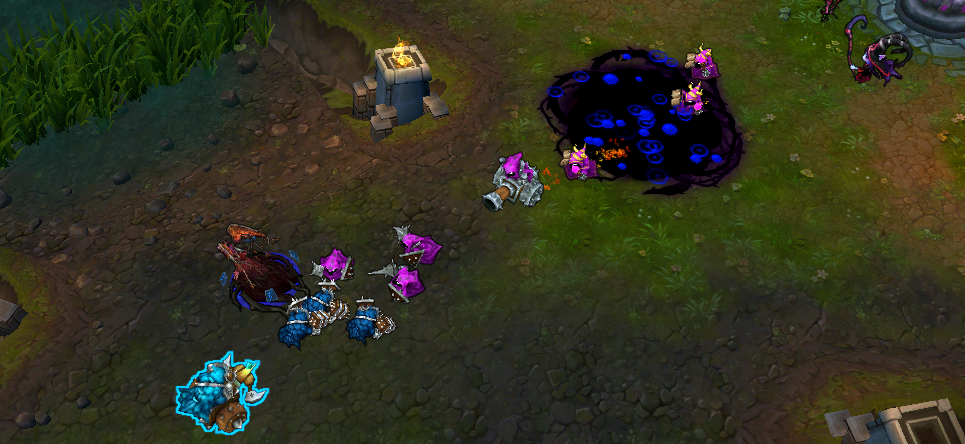
- Pushing to apply pressure
When playing mobile champions or champions with high play potential or who are just straight up difficult to kill, this method can show spectacular results. (i.e. Kayle, Lissandra, Zed) This choice is basically taking a top-lane mindset. While you cannot proxy waves as a middle laner, you can still draw jungle pressure. In certain match-ups, pushing an enemy in will prevent them from honestly, playing the game. Laning against someone like Fizz or Leblanc, a player could take advantage of their poor wave clear and push them in (although in the case of Leblanc, the benefit would be that she would be forced to max W instead of Q to effectively clear).
In addition both of these champions have two things in common: they are both assassins and both have to use their escape ability in order to clear waves. Simply by pushing champions like these two would already put them at a disadvantage. For one, they are not able to duel their lane opponent effectively with a creep wave disadvantage. Attempting an all-in becomes difficult for them as they potentially miss several creeps to the turret and also could put themselves in the way of creep aggro. As a result of the difficulty that the player experiences, they require a jungler gank. A high mobility champion will be able to bring the pressure middle and then freely escape. Alleviating pressure from the rest of the map allows for your own jungler to gank other lanes without the fear of a counter-gank and wastes other jungler's time.
- Kill potential & rotations
In winning match-ups, players tend to look for chances to outplay and kill their laning opponent. The player attempts to freeze the lane in a favorable spot and look for chances to either poke or all-in their lane opponent. They try to leave their lane open for a gank and capitalize on kills through either pushing or roaming afterward. Although this is not always a possibility, higher level players tend to lean toward either this method or pushing so that they can roam (the only difference being that they try to initially snowball off of their own lane rather than others).
Players first make their choice of what they want to play, either making the first pick, a counter-pick, or a comfort pick (in most cases, the choice is a comfort pick as well as one of the others). If the choice is not a comfort pick, it is most commonly because it is a counter-pick.
Controversy behind counter-picks
It's commonly noted that people should not play a champion solely because it is a counter-pick. That is because most people cannot apply the “why” thought process and are also likely under-practiced on their choice of character. Being aware of why a champion is considered a counter-pick is imperative to playing the match-up properly. Take for example Leona versus Thresh. Commonly, Thresh is referred to as a “soft counter” to Leona. While this is not the strongest example for counter-picking it will still validate the point trying to be made. When analyzing, the first thing to be considered is that numbers don't lie. While Thresh does have the advantage of being ranged, it's quite clear that Leona's base stats are superior in every other aspect to Thresh, making her much more effective in hard engages.
Thresh:
Leona:
If we look at the damage of skills, we see at level 3 (parentheses indicates the level 6 value) that a full rotation of skills by Leona deals 180 (410) and three (four) procs of sunlight that deal 35 (50) damage each. The value of Thresh's rotation would be 145 (475 if you have three points in death sentence) damage and a 60 point shield. These numerical values show no indication of an advantage to either side but there are several points to consider: the fact that Thresh's death sentence is a narrow, single target skill shot. On the other hand Leona's Zenith Blade is classified as a “pass-through” skill shot. In addition, Leona is able to lockdown opponents for about 3 seconds as while Thresh about 1.5 lockdown and a slow.
What makes Thresh a “counter” to Leona is not in the numbers but in the potential to prevent her from playing to her fullest potential (disengaging, poking, and playing aggressively afterward). If someone were to play Thresh as a counter to Leona without being aware of why he is, the result could potentially be abysmal. Numerically, Leona can be seen as a stronger laner and if a Thresh player lacks the knowledge or practice of the match-up, they would most likely lose it. The counter-pick is played and still lost in this case, defeating the purpose of playing it in the first place.
This may seem like a tangent, but I bring it up for a reason. While using analysis and knowledge in picks is a great thing, players should not do so if they are under-practiced or not sure why they are doing so in a ranked game. Instead, they should take the time to practice and become comfortable with a pick first. What is comfortable with a player will almost always produce a better result.
Concluding Thoughts
The process of analysis in League of Legends is a linear process that needs to be taken one step at a time. Players should look to constantly improve their knowledge of the game, their understanding of “what.” They can further dissect the facts that they know and attempt to understand “how” something plays out and “why” it does so. By practicing these concepts, players can improve in all aspects of the game. Their use of intelligent analysis and assimilation of game sense can improve decision making. While mechanical skill may not translate into actual game play, simply knowing the possibilities of situations is the first step in improving as a player.