






Blogs
The State of Hypercarries in Season 3 - Part Two: Items


If you were with us last week, we began our inspection of the health of the Hypercarry role in Season 3 of League of Legends. Last time, we looked at the changes in the metagame and of specific champions that have affected the role of Hypercarry and saw that while the change towards Assassins and high disruption Junglers was to the detriment of the most of them, the changes in the meta-game, especially the move towards 2v1 lanes, has helped AD and AP Hypercarries, while stifling the return of Jax and Tryndamere. Today's topic is the items, and to do this we're going to look at each subclass of Hypercarry and look at how the item changes in Season 3 have affected each of them.
Once again, this is a look at how healthy these changes have been for the Hypercarry class, not the game in general. Also, this isn't by any means a comprehensive look at the overall health of the Hypercarry, but rather a focused look on the changes in the item pool for Season 3. While there will be talk of pick rates or other champions, those are focused upon on other portions of this series. Finally, there is a new potential Hypercarry in the house, or perhaps returning to it: Master Yi. However, it is far too soon to make any thorough analysis on his strength or write up anything on him without me making massive assumptions about him. In future weeks we'll take a look at him, but for now, the Wuju Master will stay out of the conversation.
AD Hypercarries - A Narrow Edge of Attack Speed
Let's start our discussion on AD Hypercarries with one fact at its foundation; AD Hypercarries live and die by Attack Speed. Their damage often relies on them getting as many hits off with their damage steroid (Bio-Arcane Barrage/Silver Bolts/Spray and Pray) as they can before they are inevitably focused. However, before Season 3, the AD Hypercarry was shoehorned into taking one item for Attack Speed: Phantom Dancer. Even after Dodge was removed from the game and taken off the item, Phantom Dancer was the only real choice an AD Hypercarry had if they wanted to spec into full Attack Speed. Stark's Fervor was always a niche pick-up, despite its Life Steal and Armor reducing passive, and then it transformed into Zeke's Herald (which ditched the Attack Speed in order to masquerade as a Support item).
Trinity Force, while being chock full of stats, is far too expensive to pick up as your Attack Speed item, as it's a core item at heart, and comes with two "wasted" stats in Ability Power and Mana and a passive in Spellblade which only a few AD Carries, such as Corki, want. As such, the pool of items that any AD Carry could pick up for Attack Speed was incredibly narrow, and the focus of Phantom Dancer on Critical Strike meant that you were predisposed into going straight into Infinity Edge, trying not to waste a massive portion of your Phantom Dancer's statistics.
With this core of PD/IE, the Season 2 Hypercarry's item pool was incredibly shallow, and Riot sought to correct this, along with quite a few other stagnant things, with the changes they brought to Season 3. And change they did, bringing with them four viable items for Attack Speed and allowing all AD Carries, not only Hypercarries, to diversify their builds.
Now, variety is not inherently healthy for a role, but this variety brought with it three very strong build paths based around these attack speed items. The first and foremost is the introduction of the Blade of the Ruined King into Summoner's Rift. While it has been nerfed and underwent a small makeover, with the passive damage being changed to physical damage instead of magical, BotRK remains one of the strongest items for AD Hypercarries to pick up in Season 3. The first reason that it has become core on AD Hypercarries, is that it allows them to build early survivability in lane in the form of the Life Steal of a Vampiric Scepter/Bilgewater Cutlass. Before its introduction, AD Hypercarries had to rely on stacking Doran's Blades for survivability, which, while effective, were a short term solution with them not building into anything; or they built a Vamp Scepter and let it sit and collect dust in their inventory as they were picking up their other items.

The weapon is by far the most threatening part of this picture
But it isn't just the survivability that has made the BotRK into the primary choice of most Hypercarries, nor is it the combination of Lifesteal and Attack Speed. It's the passive and active portions of this item that make it so attractive, with the passive allowing for the already Attack Speed focused AD Hypercarries to put out an insane amount of damage. Five percent of the target's current health total being shredded on hit often ends up being eight percent a second, which helps the Hypercarry erode tankier targets while obliterating the softest members of the opposing team. And the active is potentially the most important part of this item, as the slow/movespeed slow gives the AD Hypercarry a crucial escape from lane ganks early and the ability to kite those who dive upon them during late game teamfights.
As such Blade of the Ruined King has become the core of quite a few Attack Speed focused builds, and while it sometimes requires the builder to buy more Attack Speed to make it worth their while, this isn't necessarily as mandatory as building an Infinity Edge after Phantom Dancer to take advantage of its stats.
The second and third items both come out of Zeal and offer different paths of how to combine Critical Strike and Attack Speed in an item - Statikk Shiv and Phantom Dancer. The real difference between the two items is the instant burst damage (and gratification) that Shiv provides against the consistent damage that Phantom Dancer does. They both inevitably end with the player building a Infinity Edge, and if one is going to be in long engagements, Phantom Dancer is the choice, with ten percent more Attack Speed and Critical Chance. But Shiv allows a Hypercarry that can get the drop on someone, such as Twitch, to put out a sickening amount of damage up front, and mobile champions such as Tristana can build up the static charge by moving quickly with Rocket Jump. This gives a player a choice, and it's not an illusion, as both items are viable and fit into different playstyles.
The reintroduction of Sword of the Divine allows some interesting builds, with the only "assured" Critical Strike in the game being packed into the active of an inefficient Attack Speed item. However, this is coupled with the item providing no benefit after the three hits of assured Critical Strikes have been used. This item is incredibly situational, but a champion such as Twitch can single handedly cripple an enemy team with critical hits, while refreshing its bonuses after executing those that he's whittled down with the critting Spray and Pray. Finally, the introduction of Zephyr has allowed AD Hypercarries to pick up one of the most coveted statistics in the game (Tenacity) without giving up item space, as it is put onto an Attack Speed item. This has allowed AD Hypercarries to pick up Berserker's Greaves over Mercury's Treads and therefore put out more damage.
Moving away from the Attack Speed items, there were a few changes in Season 3 that also have affected the AD Hypercarry role. The first is the introduction of the Sightstone. Now, this is undoubtably a Support item, but the wide prevalence of wards means that the Hypercarry is much safer in lane, especially in the early portions of the game when Season 2 Supports would be running out of wards. This is a massive improvement for the Hypercarry's early game, as safety allows them to do what they want (farm) without getting Jarvan the Fourth's spear firmly shoved in an uncomfortable place.
However, the changes to Randuin's Omen and Frozen Heart are both changes that hurt the Attack Damage based-damage of the AD Hypercarry. With Randuin's Omen getting a scaling attack slow on active and a guarenteed slow on being hit, and Frozen Heart being built out of Warden's Mail (which shares the Cold Steel passive of Randuin's), AD Hypercarries need to be careful when picking their targets, as they might wither their own power by firing one stray shot towards a Tank or Bruiser. However, the increased item diversity has been a good change for the AD Hypercarry, and it has allowed them to remain on solid ground despite what one may consider a dangerous shift in the champion metagame.
AP Hypercarries - The Armguard and Penetration
With AP Hypercarries, the single most important item that was introduced for them was Seeker's Armguard. Before it's introduction, AD Assassin's were making short work of every AP Mage in the mid lane except Ryze, who was able to build into a fast Glacial Shroud without sacrificing too much power. The previous recipe for Zhonya's called for a Chain Vest, which most AP's were willing to rush, but then found it to be little protection against the quick Brutalizer pick up by their lane opponent. It was an atrocious time for most AP Mages, and the squishier Hypercarries of Karthus and Cassiopeia were no exception.
The introduction of the Seeker's Armguard was a godsend for all AP Mid laners, as not only did it allow a quick build into Armor by the Mage, but it allowed them to start with Cloth Armor and five health pots, so that the red elixir start of the Assassin didn't murder them at Level 2. It also allows them to shift into a quick Hourglass which is necessary for their survival in the late game when Assassin's are present. (Or in Karthus' case, in order for him to die in the appropriate position.)
The second biggest change in items for the AP Hypercarry was the change in how penetration was calculated. Unlike AD Hypercarries, who always preferred the percentage penetration of Last Whisper over the Brutalizer because the Brutalizer built into nothing the AD Hypercarry wanted, the AP Hypercarry was forced to pick between the flat penetration of their boots or the percentage penetration of Void Staff, or pick both and lose efficiency, as the Percentage Penetration came last and therefore was much less impactful. However, now, the penetration stacks so that the Flat Magic Penetration comes after the Percentage, which means that Void Staff has become an attractive and effective item choice for the AP Hypercarry.
The introduction of the new evolution of the Archangel's Staff, Seraph's Embrace, also provides survivability for the AP Hypercarry, as the mana shield often provides around 500 to 600 health buffer that can take the bite off of some of the deadliest abilities in the game. Granted, it does cost you twenty percent of your mana pool, but that is a small price to pay for surviving. This is a massive bonus for Ryze in particular, who normally has a massive mana pool due to his mana focused champion kit.
The final huge change for Season 3 is a champion specific change, in that Cassiopeia's Twin Fangs now are treated as a single-target spell for purposes of Spell Vamp and on-hit spell abilities, most notably being Rylai's Crystal Scepter. Xypherous noted that this change terrified him and others on design, but it gives her a massive power upgrade, as a half-second nuke that can root its targets in place for more half-second nukes tends to be a powerful thing for a character to have.
Now, the recent changes to Magic Resistance will have some effect on the effectiveness of AP Hypercarries, but two things need to be stated. The first is that the Banshee's Veil change really doesn't impact Ryze as much as some naysayers have cried. Ryze players have been preferring the Abyssal Scepter for their source of Magic Resist, as it gives them the penetration aura that all their spells are within, and Banshee's Veil was seeing a decreasing play rate up to its change, seeing it in only around 20% of the games he was in. This is also because Rod of Ages tends to be a better pick up as well, and the Catalyst was easily put into that build.
Now that Banshee's doesn't have mana included in its build, it won't be commonly built on Ryze, but it wasn't a massive loss. The second is that the introduction of Spectre's Cowl will hurt champions that do their magic damage over time, trying to whittle down their lane opponents. This means that Ryze and Karthus are pretty safe from being very negatively affected by the introduction of Cowl, and while Cassiopeia's early harass will be hurt, she will still be able to burst down targets. Cowl will be more damaging to APs that are in long lanes than to the Hypercarries in the Mid lane.
Bruiser Hypercarries - Answer Cloudy, Ask Again Later
Bruiser Hypercarries find themselves in an awkward spot with the Season 3 item changes as the introduction of BotRK has been the greatest boon and bane to them. BotRK allows both Tryndamere and Jax to chase down and obliterate targets, take down tanky counterpicks such as Malphite and Cho'Gath, and be a general nuisance in the Top lane. This is a massive upgrade for them, and if it was a melee only item such as Ravenous Hydra, Bruiser Hypercarry players would celebrate. But with most AD Carries picking up the BotRK, Bruiser Hypercarries are kited by the very same item that makes them terrifying in the top lane. And as they have a larger health pool than the carries they're taking down, they often end up on the losing ends of such trades.
So, with such a situation, what are Hypercarry Bruiser's to do? Well, for Jax, Randuin's Omen is still a viable pick up, but Tryndamere is stuck trying to build up Attack Speed and Crit with Phantom Dancers (or Shivs) and Infinity Edge. Sword of the Divine isn't that appealing to either of them, unlike its predecessor which provided armor penetration, as it's limited to three strikes, and they have no real way to abuse the item between blows, unlike Master Yi or Twitch. Statikk Shiv is an interesting counterpart to Phantom Dancer for Tryndamere, but it gives less statistics and lets him fall victim to the bane of a melee character's existence: unit collision.
The new Black Cleaver isn't that appealing either, as Jax does quite a bit of his damage through magic and while Tryndamere likes the Armor shred, he has no way to apply multiple layers of it except through repeatedly beating his enemies over the head. Other than picking up a relatively inefficient Frozen Mallet (Tryndamere cares little for the additional health), Tryndamere's only option is to wait to Mocking Shout until after the Carry turns to run and uses BotRK, but then he's really not using the damage reduction side of the ability.
On dealing with AP threats, both have access to the Maw of Malmortius, which has been buffed recently. The recipe of the item also takes in consideration the early game with the Hexdrinker being available very early. Sadly for Tryndamere, it doesn't look like the Spellbreaker is going to be implemented anytime soon (which is good for all us AP players, as that item was ridiculously efficient and was going to be terrifying on Tryndamere). Zephyr does provide them both with a source of Tenacity that allows them to build Ninja Tabi or Berserker's Greaves, which is a welcome change, but all in all, Bruiser Hypercarries seem to be treading water, with no massive upgrades in the Season 3 item changes outside the double-sided sword of BotRK.
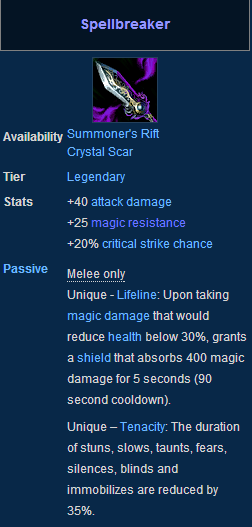
In case you were unaware of the bullet every AP player just dodged in the mid lane, here's Spellbreaker. It cost only 2800 gold.
Conclusion
In general, the Season 3 item changes have been beneficial for the Hypercarries of LoL, especially when talking about the survivability and safety of the Hypercarry in the early game. Seeker's Armguard and Blade of the Ruined King will be standard on Hypercarries until there is another massive upheaval in the item landscape. While Bruiser Hypercarries seem to have been partially negatively impacted by the changes, that only is when they have to go up against the other team's AD Carry, until which they're able to dominate with similar items.
Next week, we'll finally take a look at hard statistics by looking at each Hypercarry's professional and amateur play rates, and we'll discuss the potential of other characters to be considered Hypercarries, especially the renewed Wuju sensation. Until then, have fun on the Fields of Justice.