





Blogs
Understanding What Your Rating Means

Bayou
Tue 13th Dec 2016 - 10:56am
In the League of Legends community, there is a lot of importance and fascination that comes with your ranked rating. People treat your ranked rating as a status symbol and an all-encompassing representation of your competence in this game. A lot of people know the basics of the ranked system, but today I will go into depth on how the ranked system works, why you have the rating you have, and the math that goes into it. I believe that it is important that all League of Legends players understand this system so that they have a better understanding about why their games are made the way they are and how to climb in rating.
MMR
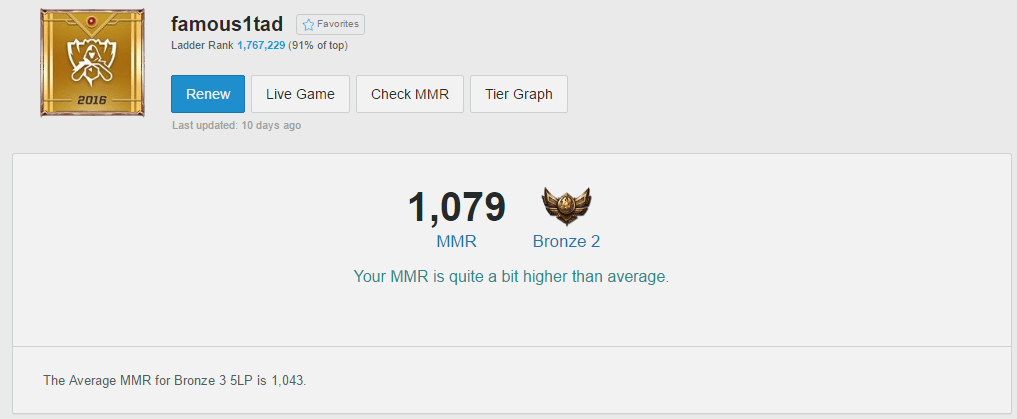
To understand the ranked system, you must understand the system behind it, MMR. MMR stands for “Matchmaking Rating,” and this is the most important number for the ranked system. The issue with MMR as a tool to measure skill, as a player, is that you can’t directly see it. MMR cannot be viewed in the League of Legends client, and there is no exact way to see what your MMR is. The only way to have an idea of your MMR is to use a third-party League of Legends statistics site, like OP.GG. These sites can predict what your MMR is based on your rating and the quality of your games. Your MMR will fluctuate with wins and losses, and is the most definitive way to measure skill for frequent ranked players.

LP
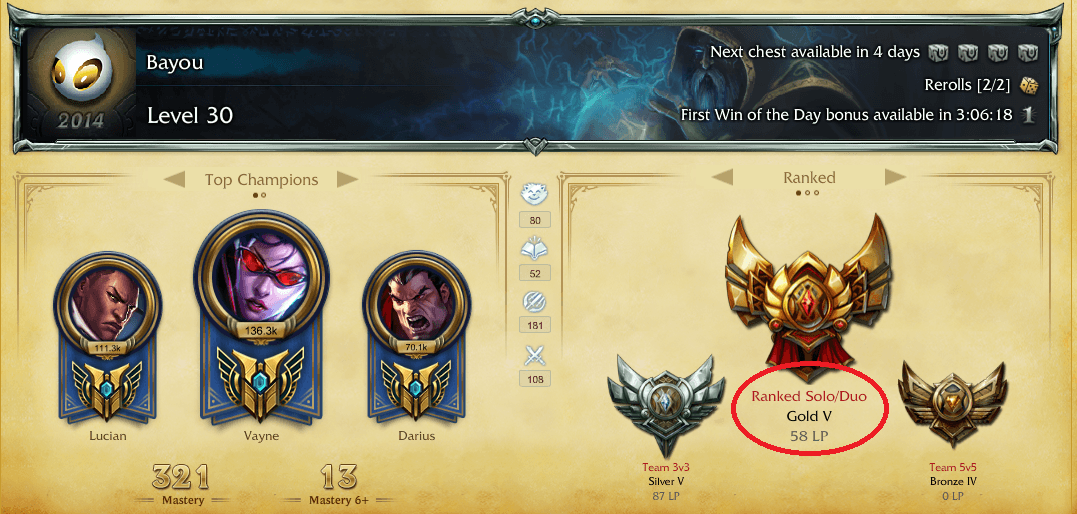
LP is most likely a system that ranked players have come to understand in League of Legends, as it is very important to your position in each division. LP, or League Points, is the direct number which the game uses to promote or demote you from division to division. Simply put, if your LP reaches one hundred, you get a series to promote out of your division. However, if it reaches zero, you will be at risk of falling out of your rating. So, knowing this, the system uses winning and losing streaks to determine changes in your rating. Unlike MMR, you can always see your LP, and you will always know your gains and losses of LP from game to game.
On average, players lose/gain around fifteen to thirty LP for each game played and that number is determined on game quality. Game quality is determined based on each team's cumulative MMR, so if one team has a higher MMR they are expected to win statistically and the other team is not. The game will base LP gains and losses accordingly.
|
Team |
LP |
|
Higher MMR Team Win |
Lower LP Gain |
|
Lower MMR Team Win |
Higher LP Gain |
|
Higher MMR Team Loss |
Higher LP Loss |
|
Lower MMR Team Loss |
Lower LP Loss |
Rating
Now we arrive to the section of the article that most people are familiar with. This is something anyone can see. You can see it scrolling through your friends list, looking someone's profile up in the League of Legends client, or using sites like OP.GG. This method of measuring skill is the least effective in my opinion, but it is an easy way to easily gain a quick idea of a player's skill. There is a large difference between a Silver player and a Platinum player. You can take a glance at someone’s rating and get an idea of how skilled that person is at League of Legends.
Rating is what people strive to improve when they play ranked. I believe this is because of the natural status symbol that having a high rating brings to you, but that is beside the point. It is a borderline shallow look at someone’s competence of the game, but it is mostly effective at its job. If you’re looking for a clearer picture regarding their skill, some more in-depth investigation is needed outside of their rating.
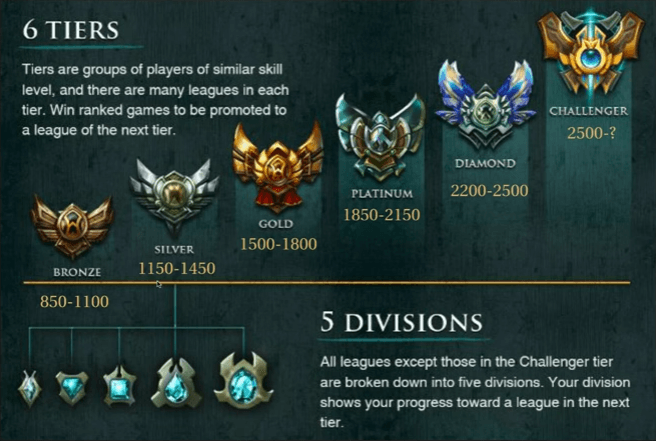 This picture was created before Master tier was added to the game, but the tiers still operate in a similar system
There are some stereotypes regarding ratings in the League of Legends community that I aim to dispel with this article. Many condemn the Bronze and Silver players in this community as poor players by default, when statistically that isn’t the case. Not many know this, but most of the community is held in Bronze and Silver. In fact, the range of Bronze II to Silver I players counts for fifty percent of the entire player base. Knowing this, this is the average rating for all players. So, if we look at it this way, only Bronze III and below are truly below average, if we are talking statistically.
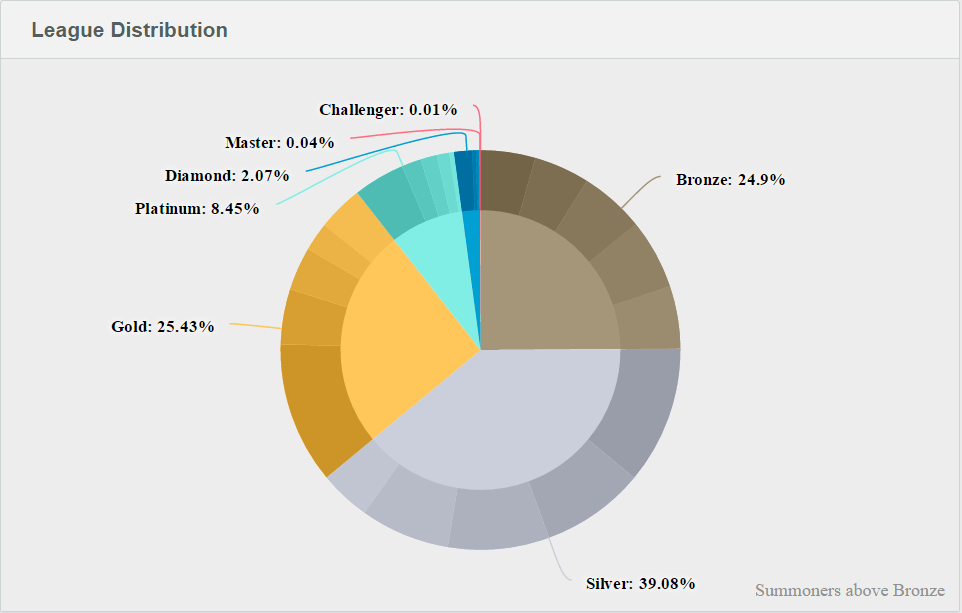 (source: http://na.op.gg/statistics/tier/)
Seeing this information, you probably didn’t expect how skewed the community is. A huge section is in Bronze and Silver, and “high rank” players are in a tiny section at the top. Personally, this was pretty eye opening information. I didn’t realize how many people were in those lower ratings and how truly small the top ratings are.
In conclusion, I hope that you gained a new perspective on the ranked system with all of this information. I believe that learning about the ranked system is imperative to understand why your ranked experience is the way that it is.
Like our content? Support us by getting our merchandise in our shop