




Blogs
The Everyman's Guide to Jungling
Levels
Mon 17th Oct 2016 - 10:10pm
Everything Was Simpler...
There comes a time when everyone asks themselves, “What the heck is jungling?”. Remember that time? A time where metas didn’t matter because everybody’s decision making and mechanics were in their comedic infancy? During the sweet, innocent pre-level 30 learning period, we all understood players were assigned to lanes. Somewhere along the line, we all got a new summoner spell called “Smite.” And that’s when we asked our more knowledgeable friends, or the internet if you didn’t have friends, “What does Smite do?”
Fast-forward to the present and there’s a clearer picture of what jungling is: ganking, pathing, smiting appropriately, builds, but mysteries about these concepts still exist. Among the vaguer ideas such as map awareness, objective trading, and a jungler’s role in teamfights, there’s still ambiguity left in how to jungle. To put it simply, I believe jungling is the easiest way to influence the game in your favor and climb elo against those who can’t jungle. So let’s talk about these key terms surrounding jungling and why you may have been doing it wrong.
General Ranked Advice
Narrow down your jungle picks down to 2 champions you love to play. Whether they’re hotly contested pro picks or lower tier junglers, pick something you’re comfortable with and have fun playing. Just don’t try questionable strategies like AP Garen - that might get you flamed and will probably lose you the game.
More importantly, maintain a learning-positive mindset to reduce tilting. I’m not going to sit on a high horse and proclaim Ranked Queue is not something worthy to be upset about. I get it, it can be frustrating, passions run high and so do emotions. Despite this, you should look at every game as a means for self-improvement. Being a toxic keyboard warrior towards your team won’t win you the game. Be rational, use the mute button, focus on your own play, and don’t take criticism about gameplay personally.
Reading The Map
To perform better than the average Bronze and Silver player, all you need to do is have proper map awareness. This means you should be looking at the map as often as you can and make calculated decisions based on what you see. In this guide, we will go over the best possible decisions to make with information given on the map.
To train this skill, go into a custom game, setup a 5v5, where you’re the only human player and everyone else is an AI. When the game starts, practice your jungling. This means working on mechanics, optimizing clear speeds, and practicing gank paths. While doing this, keep tabs on the enemy bots every time you’re not in a micro-intensive situation (farming, ganking, sieging). You do this by looking at the minimap and watching champion activity and occasionally minion waves that are going to crash into your towers. This isn’t preparing you for PvP Solo Queue. This is training you to read the minimap and interpret information to make play-making decisions.
After you do this, try the same thing in a Normal Draft game. Once again, this isn’t preparing you for PvP Solo Queue, it’s training you to look at the minimap and recognize scenarios. By doing this, you are building a foundation for good jungling.
Ganking (Within Time Windows)
Ganking, the act of appearing in a lane to overpower an enemy or pressure a turret, is probably the only thing your team will ever think you should be doing. And for good reason, ganking is the quintessential means of snowballing the game in your favor. A jungler who knows what they’re doing can influence the map and thus, create gold leads, kill leads, and objective leads. These all funnel advantages to your team and increase the likelihood of winning.
Keep in mind, when you show yourself on the minimap, the enemy team will have roughly 45 seconds (early game) where they have control of the opposite side of the map. Let’s call this a “time window,” meaning how much time you have before an enemy champion arrives and answers your play. Time windows are always a consequence of the time it takes to travel across the map.
For example, let’s say you gank top lane. This means the enemy team might try to grab an early Dragon because you showed yourself top. In this scenario, encourage your team to play passive and at the most, poke them off with long range abilities. If the enemy jungler tries to pressure bot, when you’re top, encourage them to sit way behind the turret. If the enemy mid laner is missing from the mini map, just ping your duo back as it’s soon going to be a 2v4. Tell them to back off until you can arrive and assist them.
The time window of map control in the mid game (usually after 15 minutes and before 30 minutes in the game) is around 25 seconds, given the enemy doesn’t have a Cloud Drake and tier 2 boots and other movement buffs / abilities.
The time windows of map control in the late game (after 30 minutes) is negligibly shorter, around 15 seconds or less.
Keep in mind, this is not counting respawn timers. Always add respawn timers plus travel time to create a unique time window for any scenario.
The First Gank
The first planned gank normally occurs for most junglers after you do a full clear (3 or 4 camps, maybe Scuttle Crab) and have at least 1 buff, preferably Red, since it gives your auto attacks a slow. Of course, you can always attempt the unexpected level 2 gank, or the even cheesier level 1 gank. But these strategies don’t always work because Trinket Wards are available in the opening minutes of the game. Therefore, you’re basically gambling - betting the enemies are reckless and haven’t warded the obvious areas. I rarely recommend this strategy since it makes your opposite jungle side vulnerable to counter-jungling. To sum it up, it’s a high risk, medium reward gamble. However, if your ally champion is prone to dominate due to snowballing (e.g. Riven, Katarina, Draven, etc…) the reward is slightly higher.
Target a lane that is closest to you when you end your first full clear. Path appropriately so you don’t waste time walking around your jungle trying to figure out where to gank. Time is of the essence. If your champion has a gap closer (e.g. Rek’Sai, Ekko, Elise, Graves, etc…), you’re going to have an easier time closing the distance between the enemy champion and you. The faster you close this gap, the more pressure the enemy champion will feel to burn a summoner spell. If the ally champion you are ganking for has some sort of crowd control then the gank, if executed properly, will have a high kill conversion rate. Remember, if you burn an enemy Flash, keep the pressure on. Come back in a minute to secure that kill, but remind your ally that the enemy jungler might show up if they start playing too aggressive.
For champions that don’t have gap closers (e.g. Fiddlesticks, Olaf, Udyr), you’re going to have be a bit more creative and consider invading the enemy jungle to appear from behind the enemy. You can come through the lane if your ally has reliable hard crowd control. You can also just hide in a lane brush if your ally is pushed up and you sense the enemy jungler is on the way.
Reactive Plays
In the early game and even into the late game, you will have to react to whatever the enemy is doing. Therefore, you should be making the most logical reactive plays. The best way to maintain advantages throughout the game is to secure objectives after having a numbers advantage on the map. This might happen if you successfully kill an enemy laner in a gank, got a pick, or if you have vision of the enemy on the opposite side of the map.
To get the most out of your reactive play you should value objectives, as some are more beneficial than others.
Valuing Objectives
In the early game, these are the objectives, listed from best to worse; (1) First Turret; (2) Turrets; (3) Dragon; (4) Rift Herald; (5) Red or Blue Buffs.
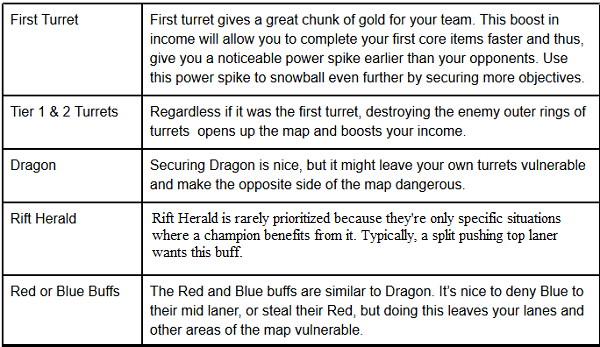
In the mid game; (1) Turrets; (2) Baron; (3) Inhibitor; (4) Inhibitor Turret; (5) Dragon; (6) Rift Herald; (7) Red or Blue Buffs.
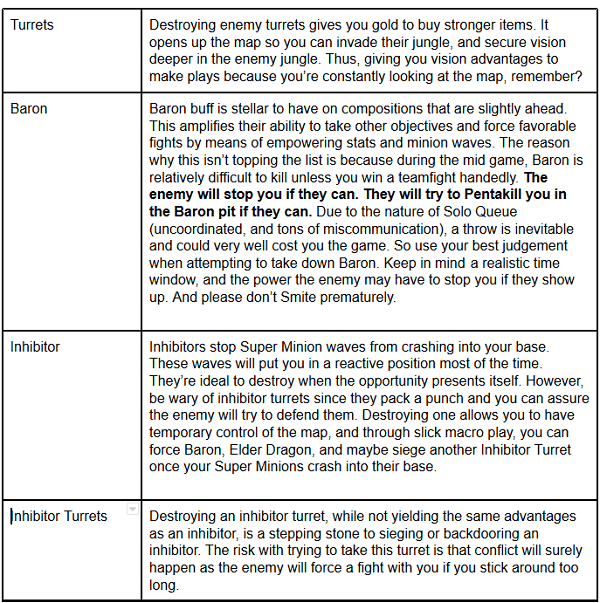
The other objectives follow the same logic as in the early game.
In the late game; (1) Nexus Turrets; (2) Baron or Elder Dragon; (3) Inhibitor; (4) Inhibitor Turrets; (5) Dragon; (6) Tier 1&2 Turrets (7) Red or Blue Buffs.
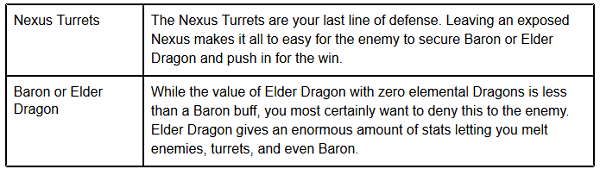
The other objectives follow the same logic as in the mid game.
Objective Trading
Now that we know the worth of different objectives in the three periods of the game, let’s think about scenarios where we need to make smart decisions.
The Early Game Scenario
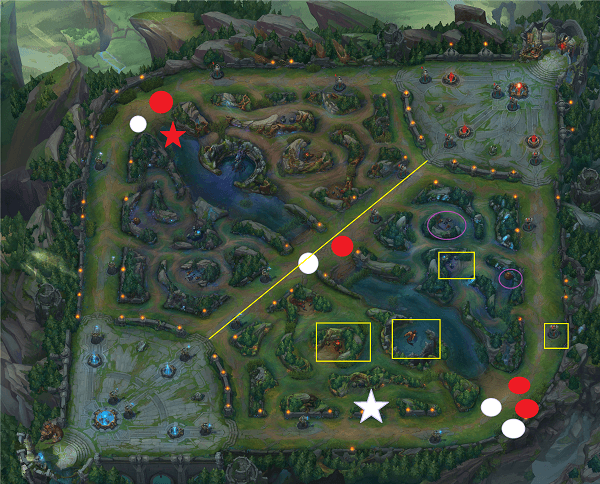
Assume all turrets are standing. The red figures represent the enemy team. The white figures represent your team. The enemy jungler is the red star, you are the white star. Here, the enemy jungler has decided to gank top. You’re on the bottom side of the map and you cannot help top as it will take too long to get there. So, you have to make an immediate decision now that you have this information.
The yellow line dividing the map represents the half you control versus the half you don’t control. You must make plays in your half. The yellow boxes have important objectives inside. The purple circles are camps you can steal if you’re in a scenario where you cannot trade an objective (e.g. you’re too low health).
Since, the first turret gold hasn’t been collected, you should try to gank bot. You should all-in them and be willing to blow your Flash to secure kills. Encourage your team to also all-in. If successful, you can force first turret gold and secure a great gold lead for your team. If the enemy duo survives with pinches of health, head to Dragon and secure that. Don’t miss Smite!
The Mid Game Scenario
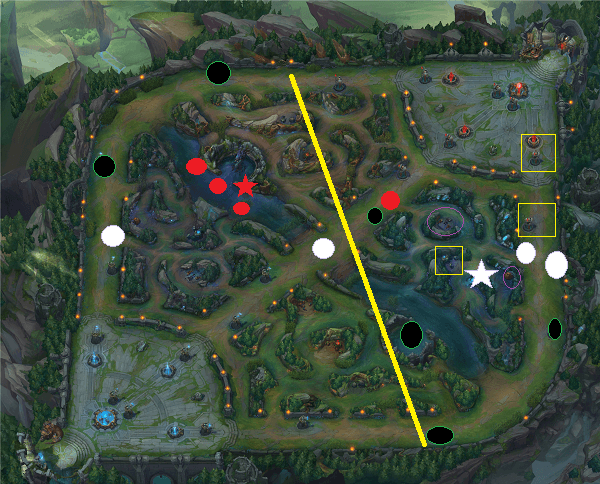
Assume the black circles represent destroyed turrets, or an empty Dragon/Baron pit. All else remains the same.
You don’t have complete vision of the Baron pit, but you saw their entire team enter the river. No one has showed up to stop your push bot. It’s safe to say they are rushing Baron because they have the numbers advantage. You are too far away to stop them. Instead, join your two allies bot and hard push. Destroy as many turrets as possible, and try to secure an inhibitor turret at least.
The most ideal play for your ally in the top lane is to distract the enemy as long as possible without dying. If they can make a hero play by giving their own life to slow down three enemies, then you’ll be able to grab an inhibitor and probably win the objective trade. Your ally in the mid lane can either help distract, stop their recalls, or hold the mid lane.
After you trade objectives, recall and shop, buy pink wards. The enemy will have Baron and will try to command the map. It’s your prerogative to play defensive and not force fights immediately. Wait out the Baron and force the enemy into a position where they cannot secure more objectives than you have. You do this by taking fights where you have more allies around. You can judge what are good fights by (you guessed it) looking at the map. It’s okay to give up tier 1 and 2 turrets but absolutely stand your ground for inhibitor turrets. However, if the enemy has all 5 Baron Buffs with Inferno Drake and a superior teamfighting comp, don’t fight. Wait until the second inhibitor is pressured or your nexus turrets.
The Late Game Scenario
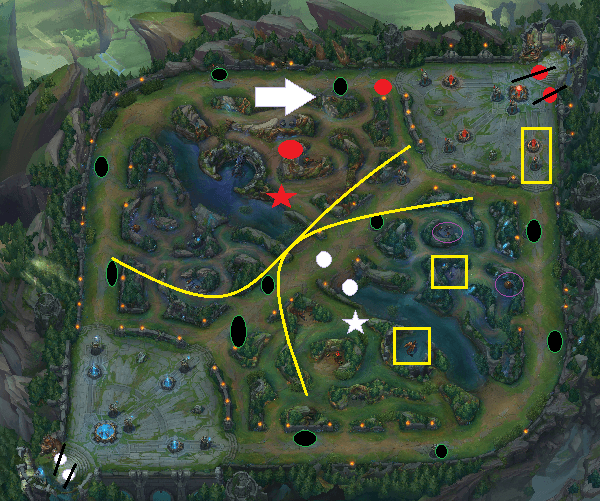
Assume the colored circles with a black dash across represent dead players on each respective team (~35 second respawn timer). Assume Elder Dragon is live. Assume the giant white arrow is your huge minion wave crashing into the top enemy inhibitor turret. You see the enemy ADC or mid laner attend the wave. You also notice the jungler and support walking around their red jungle. Assume the ally champions on the map are your ADC and your top laner.
If you are a carry jungler, do the Elder Dragon. You have the damage and a time window to kill the Elder Dragon, especially if you clear vision. Back off however, if your damage is lacking and the enemy arrives to stop you faster than expected.
If you are a tank jungler, attempt to get a pick on the enemy jungler and then do Elder Dragon as it will take a little bit more time, more than the given time window allows. If this cannot happen, push up the bot lane to potentially siege bot. Otherwise, establish vision control and set up baits. Setting up a successful bait can award you a crucial pick that could be game winning as it will mean you have a 4v5 for around a minute. That gives you enough time to push down an inhibitor or nexus turrets by winning a fight.
The Role of a Tank Jungler VS the Role of a Carry Jungler
There are different classes of champions within League. As such, there are different types of junglers. The two most distinct and widely used categories are tanks and carries. Tanks are beefy, “low damage”, frontline champs that protect their carries while they put out damage. Carries are damage threats that attempt to burst enemy squishies and look for opportunistic moments to clean up a fight. They both have the ability to win games if played correctly.
As a tank jungler, you’re going to want to farm 70% of the time before 10 minutes. This allows you to gain the income to complete your jungle item and maybe buy brown boots. If you see an opportunity to gank, you should definitely try. Whether or not you want to a gank heavy early game entirely depends on your champion's kit and what the rest of the champions on the map can do as far as crowd control and escapes.
From 10 to until 20 minutes you’re farming less, maybe only 30% of the time. What you want to transition into now is basically a play-making frontline teammate. Forcing objectives, fighting with your team, setting up sieges, and most importantly getting vision of the map to make more plays.
After 20 minutes, you shouldn’t really farm unless you have downtime, a period where nothing can be done. Your camps, buffs, and lane farm should be funneled into the carries as they will need the items to match the enemy carries. Focus on providing vision as it will allow you to take better teamfights or maybe force an objective. Remember to fight around your ultimates and cooldowns. The worst thing you can do is initiate a fight where your ADC has no Flash and instantly dies to enemy lockdown + damage. The basic idea of teamfighting as a tank is you are a meat shield for your ADC and mid laner.
For carry junglers, you want to farm about 80% of the time before 10 minutes so you get a completed jungle item, and a bit more income for boots or parts of your second core item. It’s important to not completely forget about your lanes. If every lane loses, there’s not much you can do as far as carrying.
Between the 10th and 20th minute mark, you still want to farm about 60% of the time as you will need more core items to be a serious threat. Pay attention for Dragon stacking and possible sneak Barons. Do not become an AFK farm bot. If the enemy is grouping and forcing objectives, react appropriately. Teamfighting is a bit trickier with carry junglers because you’re essentially looking to assassinate the backline threats and hope your frontline survives.
After the 20th minute mark, you should be in a position of power equal to your carries where you can seriously delete a squishy, or split push effectively.
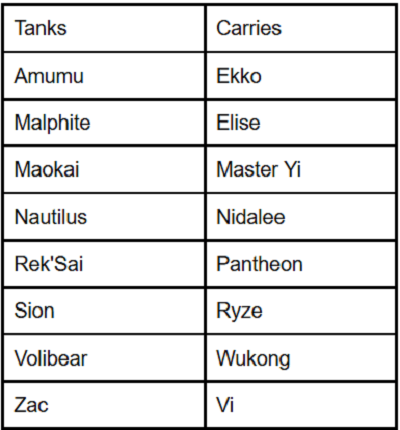
Recommended Tank and Carry Junglers
Here’s a list of junglers I think are optimal for climbing. Generally, these champs have decent kits and excel at what they’re supposed to be doing in terms of teamfighting, clear speeds, etc.
Note you don’t have to play these champions to win. It’s just a recommendation.
Support Junglers
Don’t play these junglers. In low elo, a support jungler will not enable you to pressure the map as much as a tank jungler or a carry jungler. Support junglers are generally strategic picks utilized at the highest level of play. While they are designed to introduce jungling, they are by no means equipped with the same tools as a tank jungler or a carry jungler.

Good luck out there!
Get your own AKRacing Chair here and support our players, all profit goes towards the teams!