






Blogs
Vex's Dex: Part 1
Vexagon
Mon 29th Dec 2014 - 12:55pm
When I started playing Hearthstone a few months ago, my most frustrating match-ups were against Mages and Rogues. I hated playing against these classes because nothing that I played stuck. Both of these classes have incredible amounts of removal which annoyed me in my attempt to establish board control. Every match-up was a struggle, since I was never able to handle the sheer volume of removal these two classes could put out, and this struggle impregnated me with a vendetta against these classes which I hold onto to this very day.
When GvG was released, it flooded the meta with powerful new tools, allowing classes to handle more threats, diversify their strengths, and excel in ways previously impossible. When the it was finally released onto live, I took the infinite potential of the GvG arsenal and used it to exact my petty revenge on Rogue and Mage players, with my...
Overview

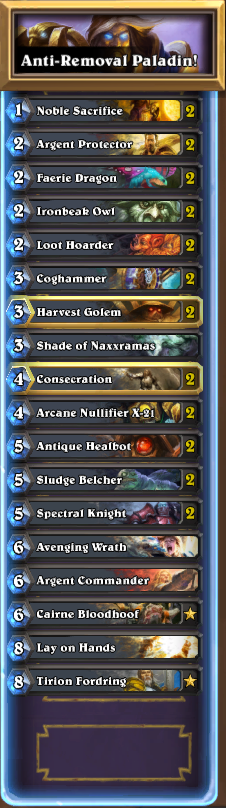
The purpose of this deck is self-evident: establish board control by filling the board with minions that are incredibly irritating to remove, either because they have multiple resistances through spell immune or divine shield effects, or if they are able to prolong death using deathrattles that ressummon minions. Confronting your opponent with several minions that take multiple turns to completely remove allows you to force board control in spite how much clear they may have.
Strengths: Resisting individual minion clear of all varieties, buffing and protecting minions.
Spell immunity means that minion is impervious to any spell that requires specific targeting (Assassinate, Fireball), and the numerous ways this deck has to provide taunt and divine shield means that your minions have some measure of protection against the other method of removal: minion, weapon damage.
Weaknesses: The Black Knight, Spellbreaker, Mass Dispel, Ironbeak Owl, Boardclear (Twisting Nether, Flamestrike), RNG-Based Spells (Cleave, Deadly Shot)
This deck takes advantage of the fact that spell immune enemies can still be targeted by single-target minion effects (Argent Protector). However, the same condition applies to your opponent, meaning that silences, damage and any other effects that are applied by minions bypass the spell immune effect. The Black Knight is able to cut down a single minion, even if it has divine shield, and an Ironbeak Owl can dispel all of the effects you worked so hard on stacking on a single minion. Take note that in addition to removing taunt and divine shield, silence will also remove the spell immune status.
Additionally, while targeted spells are ineffective, spells that do not require the player to choose the target maintain their effectiveness against spell immune targets, hitting them and dealing the full effect regardless of their status. This makes Mass Dispel in particular a uniquely effective countermeasure against this deck, allowing you to remove multiple troublesome spells in one fell swoop. If the board becaomes too overwhelming, Twisting Nether or Deathwing acts as a good last resort play, destryong minions regardless of their multiple resistances.
Deck Composition
Card Type - # of Cards (Cost)
Soulbound - 2 (0 Dust)
Naxxrammas - 5 (2800g/$24.99)
Common - 14 (560 Dust)
Rare - 3 (300 Dust)
Epic - 4 (1600 Dust)
Legendary - 2 (3200 Dust)
Total - 30 (5660 Dust + Naxxrammas)
Cards Per Set
Basic - 2
Naxxrammas - 5
Expert - 17
Goblins Vs. Gnomes - 6
Deck Synergies and Combos
This deck has many potent standalone cards that are further enhanced by other supporting cards. Utilizing these combos to create an advantage and frustrating your opponent is key to winning with this deck.
Coghammer + Faerie Dragon (5 mana) - A very early combo that can be accomplished as early as turn 3, this puts a spell immune taunt with divine shield on the board and a reasonably strong weapon in your hands.
Coghammer + Spectral Knight (8 mana) - A more advanced combo that serves a similar purpose as Coghammer + Faerie Dragon, but has the added benefit of increased durability thanks to the relatively large pool of health of Spectcal Knight. Because of the random nature of the Coghammer effect and the relatively high mana cost of this combo, this card combo is generally best used to start to reestablish board control with a huge, burderline invulnerable minion if you have somehow lost it this late into the game.
Coghammer + Shade of Naxxrammas (6 mana) - This "submersible" shield allows you to set it up in the early game and leave it alone until you need it. The earlier you set this combo up and the longer you leave it stand the stronger it gets thanks to SoN's passive +1/+1 per turn stat gain, giving this already threatening "timebomb" card a splash of strategic defensive value. Additionally, the divine shield that SoN gains from Coghammer will protect it and allow it to recover from any full-board waveclear the opponent will try to kill it with before it grows out of hand. It is even resistant to powerful waveclear combos like Equality + Consecrate since its passive will somewhat restore lost stats. Be aware though that this combo, once it emerges, is very easily shut down by any silences the opponent may have, even in spell form, which means the longer you prepare to use this combo the more value your opponent will get from the silence they use on it.
Arcane Nullifier X-21 + Argent Protector (6 mana) - The "perfect shield" combo, this establishes a high health, spell immune, divine shield taunt relatively early on without the use of a Coghammer. Arcane Nullifier X-21 is one of my favorite GvG cards. It is essentially a Senjin Shieldmasta that sacrifices 1 attack in exchange for being doubly hard to remove, since decks equipped to deal with the former are usually unprepared for the latter. Argent Protector is key in this deck because it is able to equip your ANX-21 with a divine shield, since being spell immune means that any Hand of Protection cards you may seek to use on it will not be effective.
+---+---+
In earlier versions of this deck there were some card combinations that were potent and effective but were too context-specific or not worth waiting for and were excluded from the final version. They were fun nonetheless so here I will discuss some cut-but-powerful combos of the Anti-Removal Paladin.
Noble Sacrifice + Avenge + Any Minion (2+x mana) - A unique and noteworthy interaction I discovered completely by accident. The defender summoned when the Noble Sacrifice secret is activated counts as a minion death, triggering the stat-boosting effects of Avenge. This effectively adds up to a wasted enemy minion attack ( or indeed a dead minion altogether) and a more formidible minion on the field then before they decided to go on the offensive. Having to account for a stronger enemy minion due to your own actions is a tricky thing to so, and this is how the "Vengeful Sacrifice" combination disadvantages an opponent. This is, indeed, a combo that is worth more than the sum of its parts.
Tirion Fordring + Redemption (9 mana) - A combination that existed before GvG or even Naxxrammas, this combination still fits the theme of "difficult removal" that this deck is built around. While Tirion has respectable base stats, its real value is based in all of the ancilliary effects it comes equipped with: Taunt, Divine Shield, and a Deathrattle that puts one of the most powerful weapons in the game in the hands of your hero. Because of the incredible value of Tirion's effects, it is both painful for your enemy to leave it on the board or remove it. So why not double that pain? When Tirion dies on an enemy turn and is resurrected by Redemption, all of it's effects are renewed: it regains its divine shield and is prepared to re-equip Uther with a second Ashbringer. This combo could be made less expensive by replacing Tirion with a Sunwalker while still preserving most of it's usefulness, since you are saving 2 mana and only sacrificing what would usually be a redundant deathrattle effect.
Another important perspective to consider is that the cumulative value of Tirion's effects makes it massive silence-bait (since a 6-6 body, while formidible, is not comparable with that of other 8 mana minions). However, with Redemption on the board, all is not lost! Simply allow your opponent to destroy the old, silenced Tirion and trade him in for a new, slightly damaged Tirion with its effects renewed! While this strategy takes a bit more baiting of your opponent, it can be effective in renewing Tirion's incredibly valuable effects if you do not have a minion-return mechanic on hand.
The Curve
The Anti-Removal Paladin (or at least this iteration of it) does not have the most stable curve. It compensates for this by having spikes in areas that correspond with phases of the game that are the most imperative to influence. The largest spike at the 2-mana card area means that your mulligans will almost certainly start you off with a card or two that will allow you to assert board control early on (usually through use of your Coghammer and A Faerie Dragon or Harvest Golem) or at least contend with any significant threats your opponent may come up with. The amounts of 3- and 4-mana cards are insignificantly lower than the 2-mana spike, since 4-5 midrange cards means you will still have something to play as the early game dissipates. Additionally, you are able to consume any extra mana with your hero power, summoning Silver Hand Knights which serve to whittle down small and medium-sized threats down to health levels where they can then be taken care of by your weapon-equuipped hero, one of your larger minions, or even just a Consecrate. Silver Hand Knights are also great at popping divine shields or cleaning up the weakened remains of enemy minions after an Avenging Wrath salvo, so it is always useful to keep 1 or 2 on the board if you can afford it.
The second spike occurs at the 5-mana region is filled entirely by minions. 5 mana cards are expensive to have in your opening hand but not so much so where they are burdensome if they are added to your hand through the mulligan process since they can be coined in on turn four or can be counted on to somewhat regain any board presence lost as a result of not getting the ideal number of early game cards. The 5 mana cards in this particular deck excel at stabilizing from several types of disadvantage: Sludge Belcher if the enemy has several minions played that need to be blocked from going to face, Spectral Knight to present a large, healthy hard to remove minion that may distract the opponent from dealing direct damage, and Antique Healbot to restore a large amount of lost to an aggressive early game deck like Facehunter or Zoolock. All of these minions are equally as good at emphasizing advantages as they are at compensating for disadvantages, with Spectral Knight just being another spell-immune Coghammer building block, Sludge Belcher being the ubiquitously annoying taunt, and Antique Healbot healing off the damage you will have no doubt incurred removing minions with your hero's Coghammer.
The 6 and 7+ mana bars are where the curve for this deck descends, since the few high mana cards in this deck are to be played situationally. Tirion is incredibly strong, but a generally risky play even in the late game considering that it is vulnerable to Hex, Polymorph, Earth Shock and every other spell the enemy was unable to use on the minions in the early game (it is actually due to this phenomenon that the Tirion+Redemption combo I described earlier was scrapped because I'd end up resurrecting a sheep or a frog half of the time). Lay on Hands is a late-game turnaround gambit when you are low on health and out of cards, and generally to be saved for emergency situations. Argent Commander is most effectively used as on-the-fly removal that also leaves a 4/2 body on the field. Cairne is a powerful standalone minion that can really be summoned at any time to great effect.
Non-Core Cards
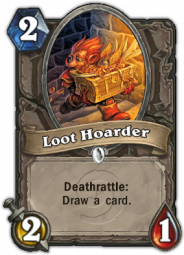 - This universally useful 2 mana minion accomplishes several goals in the Anti-Removal Paladin deck. First and foremost, its deathrattle allows you to draw a card. In earlier iterations of this deck I would frequently find myself running out of cards trying to outpace my opponent in the early game. THis was troublesome because if the enemy somehow were able to clear the first wave of minions I would have few resources to muster for a secondary defense.
Next, Loot Hoarder, in its own special way, fits the theme of anti-removal because the reactions of some enemies will be to deprive you of the card draw that the Loot Hoarder's death would grant you. This means that the Loot Hoarder will accomplish one of three things:
1. Enemy removes Loot Hoarder quickly; Loot Hoarder will live a short life that ends in a card draw.
2. Enemy pauses in his attempt to control the board; Loot Hoarder will live a longer life that ends in a card draw.
3. Loot Hoarder will absorb a silence in the enemy deck, removing that threat against any of your bigger threats, particularly Tirion Fordring. The lifespan of Loot Hoarder in this scenario is irrelevant.
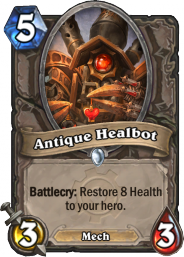 - Another card addition that resulted from early iteration problems, Antique Healbot was drafted in response from the large amounts of damage that I incurred using Coghammer as a weapon. Coghammer, having 2 attack and 3 durability, is a great weapon for popping divine shields, picking off weak targets and denting the health of larger targets. To preserve the efficacy of the weapon in the lategame (allowing you to use it against the larger mosters likely to apear in the lategame with relative safety), the large amount of health that Antique Healbot restores allows you to be more ambitious with your use of Coghammer as a weapon.
Additionally, the Healbot specifically frustrates Mages, a class with the secret spell Mirror Entity, which copies the next minion that you summon. Using a similar strategy that allows Ironbeak Owl to be so effective against Mages, Antique Healbot is a good option to have against a Mage running Mirror Entity, since summoning it means that you benefit from the restored HP and can pop the enemy secret, giving them a relatively weak 3/3 body.
- A relatively strong standalone card, Avenging Wrath accomplishes the task of being what I call "uneaven clear". For context, we can consider Consecration "even clear", since it does the same amount of damage (2) to every enemy body. Avenging Wrath's clear is "uneven" since it has a total value of damage (8) and spreads it randomly across the enemy army. Consecration is great when faces with a board of 1- and 2-health minions, whereas Avenging Wrath is great for clearing a small number of 1- to 4-health minions, or at least bringing meatier targets down to a HP level where they can be knocked off with a coghammer or a Silver Hand Recruit. Finally, against an empty board, Avenging Wrath can also be a very cinematic 8 damage to the face. I recommend casting it while emoting threats.
- Per it's flavor text, Lay on Hands is, indeed, a grammatically awkward life saver. When you are on your last legs this will be the card you will hope to topdeck. Lay on Hands restores a sizeable amount of health and gives you 3 cards. What the Loot Hoarders and Healbots accomplish in the early and mid game Lay on Hands accomplishes in the late game. Not much else can be said about this card without overstating how solid of a lifeline it is.
Possible Improvements
- Troggzor and his lineage of magic-hating troggs beautifully compliment the theme of anti-removal that this deck is focused around. Fitting into the late game curve, Troggzor would immediately respond to the spells the enemy has been saving, unable to hit anything else with them, by swelling your ranks with more minions who, themselves, react to spells with increased attack stats. Troggzor's tendency to further discourage enemy spell use means that he would probably be more useful than dear Tirion Fordring in the Anti-Removal Paladin deck.
- Replacing Loot Hoarder with Shielded Minibot would sacrifice the free card draw in exchange for a more durable minion with actual sticking power. It would also lessen somewhat your reliance on the Coghammer + Faerie Dragon combo for early game dominance, and, being vulnerable to spells but not damage, it may absorb owls or early removal spells like Earthshock used by hasty opponents. The Shielded Minibot can act more like an actual minion, whereas you use the Loot Hoarder almost singularly for the card draw (unless you are running an Undertaker deck).
Conclusion
In a meta that sees Mage and Warrior getting stronger and stronger every day, the Anti-Removal Paladin carves its niche. Beyond that, it is also just a fun deck to play. If you share my hatred of Mages and Rogues, give this deck a chance and enjoy the mounting frustration this instills in them.
"Your magic shall not save you" - Spellbreaker