




Blogs
How to Not Throw Away Rounds: The Value of a Living Player
PeterHusisian
Thu 25th Feb 2016 - 1:41pm
In many instances, proper Counter-Strike boils down to a correct weighting of risk-reward scenarios. The circumstances of the round, your role in the team, the state of your team’s economy, and more can dictate the proper decision to take at any given moment. It can be difficult to bear these factors in mind sometimes, especially when an opportunity for a large number of kills seems to have presented itself to you. If those kills are not necessary for your success in the round, they ought not to be attempted.
A fundamental concept behind proper Counter-Terrorist play is the ability to delay a hoard of Terrorists for as long as possible to give your teammates more time to rotate to the site to either retake it or aid you in holding it. Because of this, oftentimes the best play as a Counter-Terrorist isn’t one that gives you the opportunity to net a clump of kills, but rather that will allow your teammates the easiest route of retaking the site, such as holding off the plant for as long as possible or even keeping the Terrorists from planting all-together. This allows your teammates to rotate into positions from which they can assist you in holding the site as well.
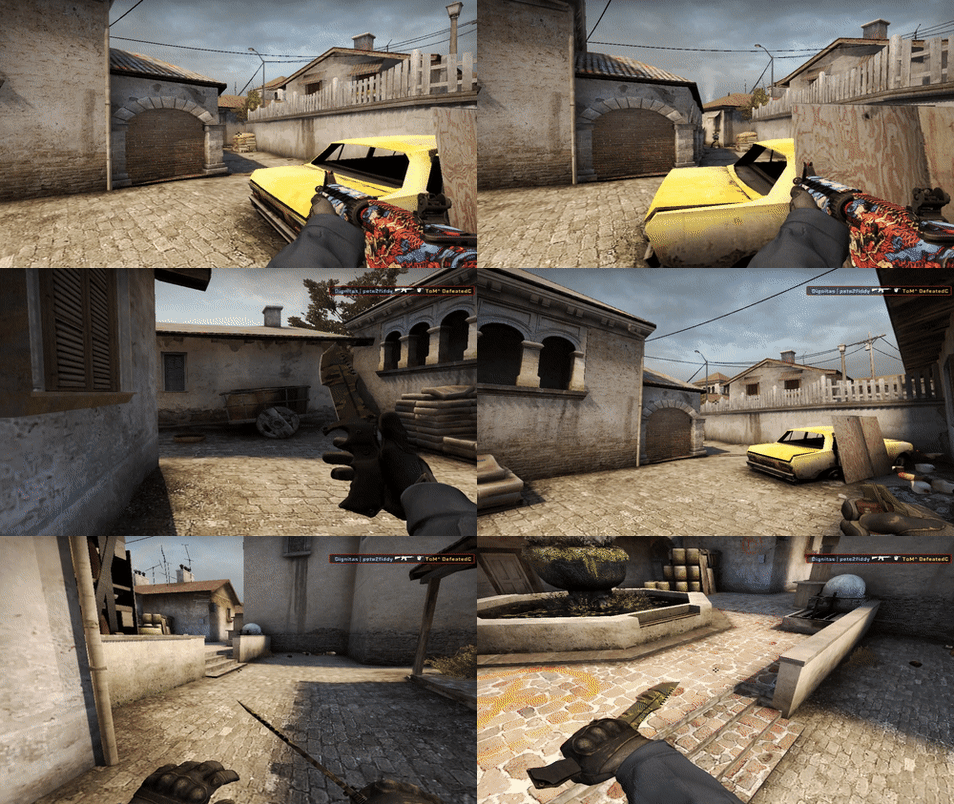 An example of an aggressive play at Banana that nets a kill, and falling back as a result.
As such, examples of when your life should best not be thrown away are largely pertinent on the Counter-Terrorist side. It is common for CTs to aggress towards one end of the map in order to gain information on the whereabouts of the Terrorists. Continuing to aggress towards these ends of the maps serves two purposes: cutting off that route from Terrorist attack and delaying their progression into a bombsite. This method of play is most easily likened to the aggressive Banana control on Inferno that many pro teams stress; smoking either close or deep Banana so they can play from forward positions in that critical part of the map. However, this method of play embodies a dangerous dance between the risk of maintaining that contested area and the likelihood of winning the round because of it.
The risk in this play is that, the longer you wait, the more likely that the Terrorists will group up and coordinate a push against you and your teammates playing in that area with you. If they do, they will easily overwhelm you, leaving the entire site open for the taking while your remaining teammates are too far away to rotate quickly to retake. Given that failure is detrimental, the moment that the benefit from further stalling the Terrorists’ approach is outweighed by the likelihood of you and your teammates dying, it is best for you to fall back onto site and further stall the Terrorists from there, but this time with eventual aid from teammates whom you will ask to rotate over.
A video from voo CSGO about the importance of "not dying."
This concept is especially crucial as a solo bombsite holder. Given that you are on your own, you will be easily overwhelmed by a large number of Terrorists if you attempt to take every aim duel. Instead, concentrate your efforts on keeping the Terrorists at bay for as long as possible, and only attempt kills when it is favorable for you to do so (for example, if there is no way you will get shot by another Terrorist). Utilize your utility, especially smokes and flashes, to further withhold the Terrorists’ approach so that your teammates can come to your aid.
This mindset should be applied to any aggressive decision, no matter how small. Whenever you are thinking of making any sort of move, weigh the risk behind it and determine if the potential reward is worth it. As a CT, if your team is a man up, aggressing into an area of the map may not be the best idea. If you hold some advantage over the opposite side, namely in utility or weapons, making risky plays can be the gateway for the other team into winning a round they ought not to be able to win. For example, aggressing into an Eco round has the opportunity of you netting multiple kills on your vulnerable opponents with no armor or proper weaponry, but just as easily could end with them ganging up on you and opening up a portion of the map for Terrorist control, single-handedly giving the round away.
This concept is applicable to the Terrorist side, as well. Some engagements you take will be favorable, and others not. The prime example of this is peeking an AWP with a rifle – the AWP has a huge advantage over you, and the only thing that could turn the tide of the engagement is being able to best him with raw aim alone, which is a factor that shouldn’t be too heavily relied upon. In addition, rather than peeking multiple CTs at once, instead try to use utility to isolate an angle, ask for a teammate to cover the other dangerous angles with you, or give up on the duel altogether.
This isn’t to say passivity is the proper method for perfect play – just as often the tide of a round can be turned by aggression and can be just as useful a tool as keeping in mind the impact of yourself as a living player can be. In general, the methods covered in this article are most useful in winning rounds you ought not to lose, while aggression can help to wrench what would normally be a lost round from the clutches of the opposing team, but we’ll save that for another time.
Are you into fantasy leagues? Then check out AlphaDraft and put together your allstar lineup!