






Blogs
Effectively reading and using the economy in CSGO

Will-
Tue 15th Dec 2015 - 8:53am
Something that isn't thought of very often in matchmaking and PUGs is the reading of the economy and acting upon how much money the enemy has. Things such as coordinating your buys to take advantage of their situation, or knowing if it's worth risking a force buy in order to try and contain the enemy economy. Reading the economy is essential at a semi-professional and professional level play and can be seen in some POV videos available on YouTube.
Standard round bonuses
The most effective way to read the economy of the game is to be aware of the amount of money that the other team, and your team, will receive each round. An easy way to remember this is the first round loss will give the entire team $1400, and every round after that $500 added to the previous bonus. For example, the second round $1900, third $2400, etc.
It's important to remember that the outcome of the round also changes the round bonus received. The most obvious example of this is that if a T player dies or survives after the time runs out without the bomb being planted, they will not receive any money. This can result in a player starting a round with $0 and having no equipment. Because of this rule, if you can afford to do so, you should try and kill any saving T players at the end of a round to essentially force them onto an eco. If the T side plants the bomb in any round, then all the T side players receive an extra $800, with only the bomb planter receiving $300. In a similar way to this, if the bomb gets defused, the defuser is given an extra $300.
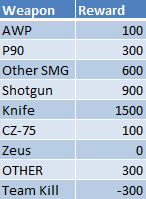
It goes without saying that kills give a reward that changes dependent on the weapon that you use. For example all SMGs give $600, apart from the P90 which gives $300. A knife kill gives a large $1500. A full guide on all weapon rewards can be found here.
Reading the Economy - T Side
When you're on T side, simply keeping control of the enemy economy is enough to gain a large amount of rounds. The reason for this is that the CT side rifles are more expensive than the T side alternatives, the M4A1-S and M4A4 both priced at $3100, whereas the AK-47 is only $2700. Additionally, the CT side are likely to want to have at least a few defuse kits, which are $400 each. As a result of this, for the CT side to gain a "full buy" including full set of grenades and a defuse kit, they will need $5500, or $7150 for an AWP, as opposed to the T side needing only $4700 for an AK-47, or $6750 for an AWP.
Being able to read when the CT side is likely going to be on a weak buy or eco is important in making a decision about which strategy you want to run. An example of why this is important to note is that the CT side might elect to "stack" a site with pistols, which means you could cautiously move into a site and try to find a stack, and act accordingly. Being able to read this changes in every situation, however if you keep track of roughly how much the other team will have by using the built in feature on the scoreboard which shows round history (including how the round was won, and how many of each team survived), you should be able to fairly consistently read what sort of buy the enemy will have. The simplest example of this is if the CT side lose pistol and force buy in the second round, it is impossible for them to have an AWP in round 4. The reasoning for this is that each player will have almost $0 after buying in round 2. This means that if they lose round 2, they'll start round 3 with roughly $1900 due to losing two rounds in a row. After this, they'll usually full eco in round 3 so that they can get a buy. This means that in round 4, they'll have approximately $4300, which, as we saw earlier, isn't enough to have an AWP full buy, or even a full buy with an M4. Using this information, you know that the CT side are either going to have weak rifles or limited grenades, and can act accordingly.
Knowing when you should force buy is also very useful when you're on T side. The reason for this is again, how expensive it is to full buy on CT side. If you lose a round and know that the CT economy is still very weak (as a result of the CT side winning their first round in a row with only one man alive). The risk/reward in this situation makes it worth considering a force buy to try and force the CT side onto a double eco.
If you read the economy like this, you should be able to control the CT economy and win a large amount of rounds because of the amount of eco rounds the CTs have to do. This will also allow you to gain a stronger economy, since if you know the CT side will be on eco, you can buy an SMG and gain a large amount of money from the $600 reward per kill.
Reading the Economy - CT Side
Reading the economy on CT side is more about knowing when to expect an eco from the T side rather than controlling the economy of the enemies. That's not to say however that you can't control the T side economy. In the same way that you can be force an eco on T side, you can on CT side as well. The same principle applies as previously, where you can risk a force buy to try to ensure an eco from the opponents.
Knowing when to expect an eco from the T side can be done by examining the recent round wins/losses, and figuring out approximately how much money the enemy will have. If you can read this effectively, you'll be able to change your CT set-up in order to accommodate for a likely rush or fast play by the opposition; for example, you could rotate another man towards the B site of Inferno, or you could change positions that you hold to make a long range engagement a lot more likely, giving you a large chance of winning the round.
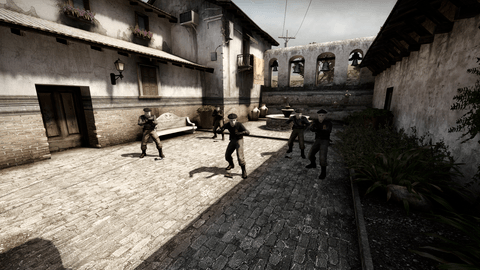
Team EnVyUs are infamous for successful force buys.
In Conclusion
Everyone loves an economist in CS, even in matchmaking or a pug. You should always be aware of the economy of the opponents, not just in the first four rounds of each half. This should have given you a better understanding of how to read the economy in the game, as well as how you can apply it in your games.