




Blogs
Ranking Up: Round Development

Hello and welcome to Ranking Up; a series where I help you improve your skills in CSGO and rank up in matchmaking! Today's topic is round development.
This may sound weird but let me explain it in terms of chess. In chess, knowing how to play chess isn't simply knowing how the pieces move, it's knowing how to use them and do so effectively. The same goes with CSGO, knowing how to shoot your gun and walk around is a good starting point, but this isn't knowing how to play CSGO. Now when I say round development you may wonder exactly what I mean, chess is a perfect reference for this because it follows three stages; the opening (or early game), the middle game, and late game. The opening is how you want to initially set up your pieces, making sure you have your king protected and your major pieces in play. The middle game is more focused on attacking or defending, trying to get the better positioning, and trading pieces for a tactical advantage. Lastly, the late game, is about pure mental processing and knowing every possible move your opponent could make and either stopping it or using it against them. This, as you can probably tell by now, is a great translation for CSGO, so let's get into round development and how you should understand it.
Early Game (The Opening)
In chess, there are tons and tons of openings and opening variations; dragon opening, accelerated dragon opening, slav defense, king's gambit, queen's gambit, etc. Some players master only a few openings while other will use them all to surprise an opponent. Like a grandmaster in chess would you should become, at the very least, proficient in one particular role or spot when starting the round. The translation for those with a full team is to know multiple opening round strategies but at least know one very very well. So for example on Inferno, I can play almost any position but I am most experienced and skilled at playing as a B-site anchor on CT corner or new box. This allows my team and me to know how I can be effectively used. From a full team and in game leader example I understand that one of my teammates is an experienced awper and another is a great rifler and they aren't nearly as effective the other way around, so I have a set opening for putting an awp in someone's hands where they can have massive control while I put a rifle in another person's hands in a position with an effective choke point.
The early game is about covering your bases and knowing what you need to get done and putting yourself or your team into a position that is ready to get the job done.
So my suggestions for a map like Inferno; as a CT I could hold CT corner on B-site and ask my archway player to smoke Banana cart for me. This will deter terrorists from pushing the site in an all out rush, and if they choose to anyways then they will be at a massive disadvantage. As a T I would consider flashing into banana and position myself behind logs to start clearing out the car/sandbags area to relay to my team that it is safe.
Below I've provided a csgoboard image highlighting the positions I've described in purple for CT side and yellow for T side.
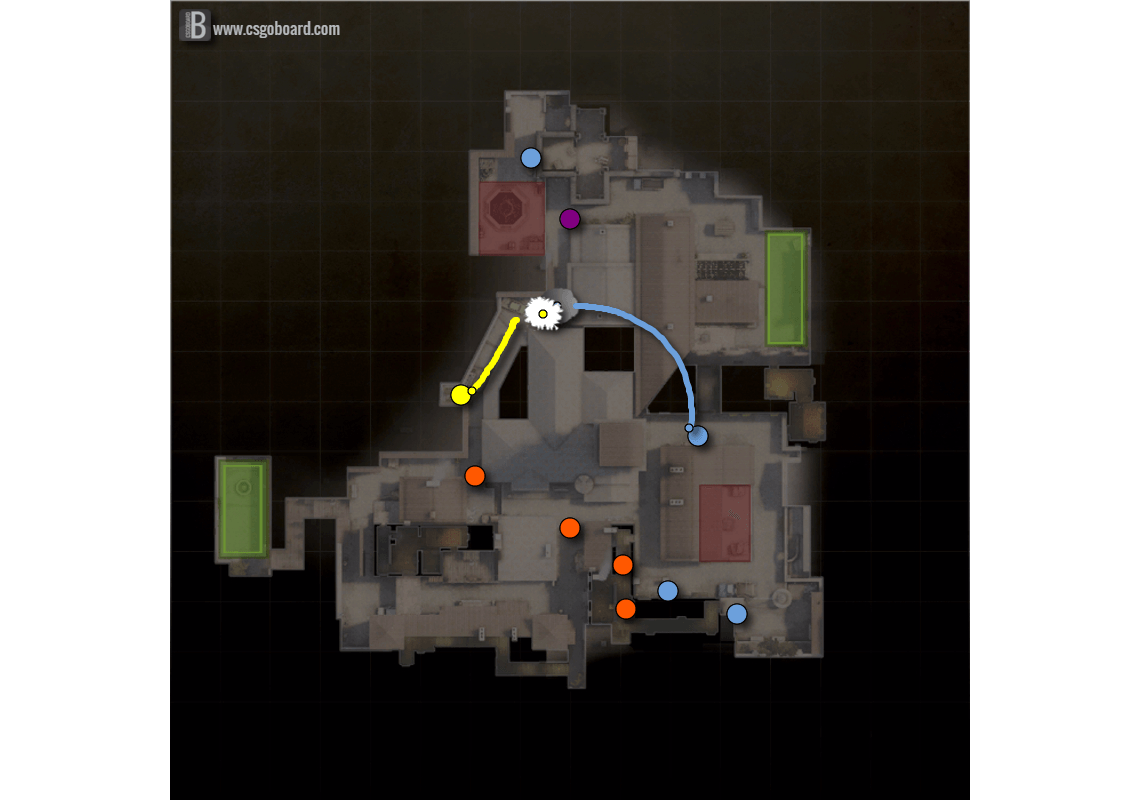
Both of these options are useful because as CT my goal is to keep the site safe from bomb plants and by having an early smoke from archway, me and another teammate can resmoke and deter terrorists from executing. The T side strategy also works because I am gaining control over an area next to a bombsite so I can gain information on where the CTs are places and let my team know if we can execute on that site.
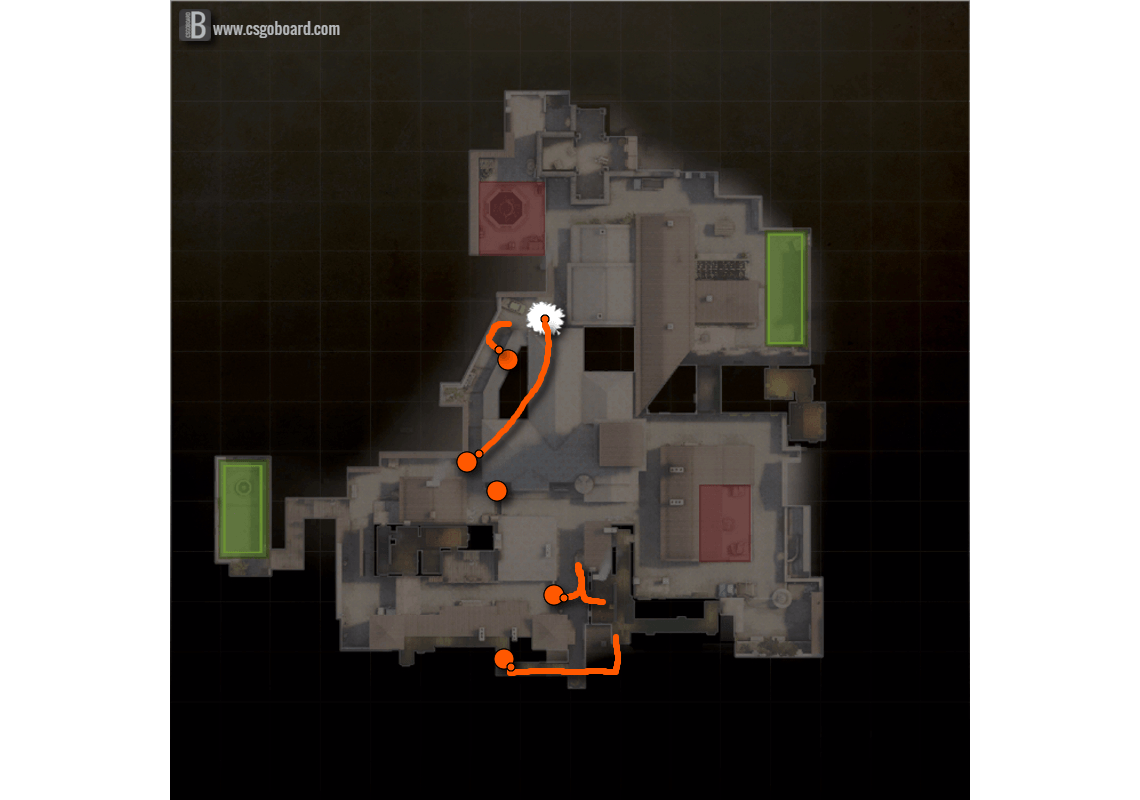
Now as an in game leader possible strategies are usually called "defaults". Default strategies are positions that you take in the opening round (e.g. one T banana, one awper T-stairs, one alt-mid or haystack, two in apartments) and you develop it as the round goes on, the following image is an example of a possible default. Looking towards pro teams is the best way to find an opening default so you can mimick it and create your own.
But wait, what do you do after you use an opening strategy? You enter mid game strategies.
Mid Game
As I said earlier, in chess the early game is about preparing yourself for your goal and the mid game is about fighting for your goal. In mid game chess is when you start to attack other pieces and defend your own, you build tension by defending an attacking piece, causing your opponent to back away or lose a piece. In chess you should never let a piece die for free, you must trade the piece or you put yourself at a huge disadvantage. The only time you should ever lose a piece and not trade back for it, is if it will result in an imminent, unstoppable checkmate that will secure you the win. So in CSGO, the idea is the same.
As T side, mid game is when you start advancing and looking for tension and kills. To progress in the mid game you need to force an opponent to back away, render them useless, or kill them. This is done by straight up fragging; executing with smokes, flashes, explosives, and molotovs; or a combination of the two. The choice depends on your style of play or how you want the opponents to react. Mid game strategies and based off of what happens and what you know from the early game. You wouldn't full smoke and flash execute B if you know that it's stacked with four CTs in the site. So in the mid game, you need to assess the early game knowledge and adapt. If you know there are three A and you have three people in banana, a possible idea is to fake an execute onto A to scare a B site CT into rotating over, giving you an easier time executing at B. No matter what you do, you need to take into account the information of the early game. This is when you execute onto a site and send your entry fragger in to either secure a kill or bait out a CT, then if your entry fragger dies, you trade the kill.
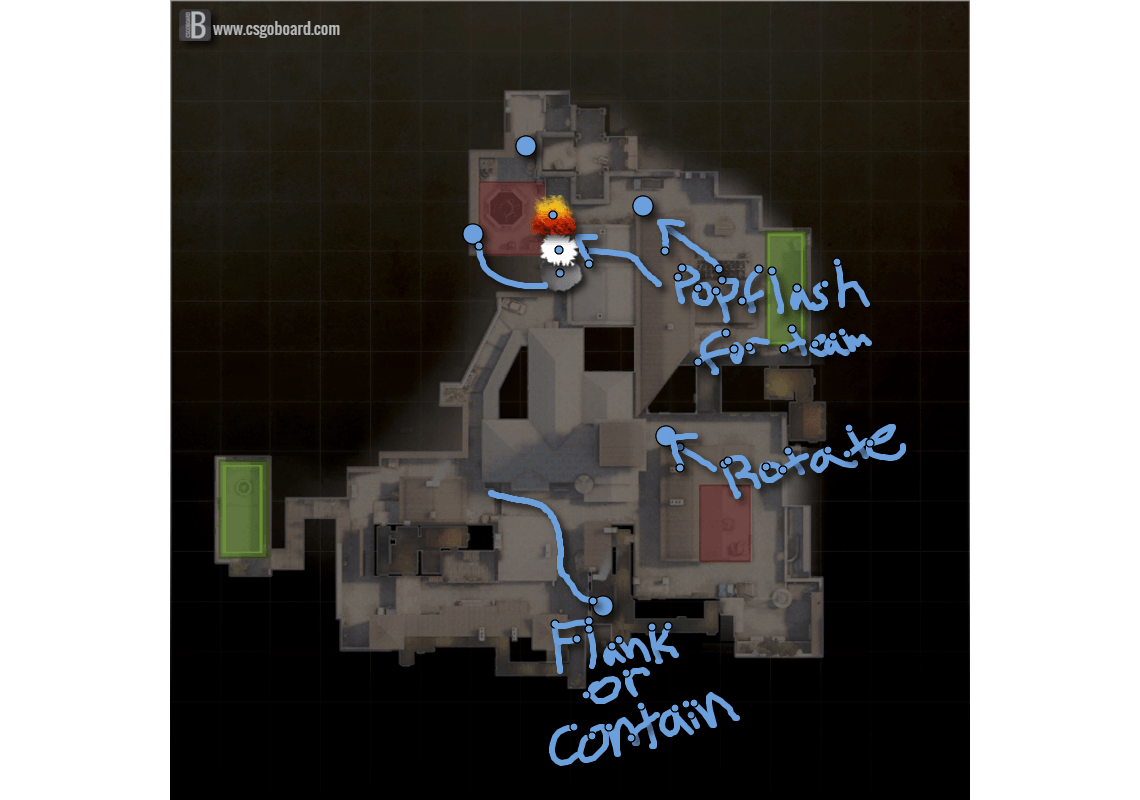
As CT side, the mid game is about rotation, containment, and stalling. You must focus on rotating a player when you believe there is a threat of an execution (I will go more in-depth on rotations in my next article), gaining vision and control, and stalling and making an execute harder to do. If your team hears a lot of footsteps and smokes being thrown at banana, maybe the archway player should rotate. If your arch player rotates and a couple of frags happen back an forth but they still haven't taken site, then you should consider advancing an A player. When you do this you can have that player gain information on where they are and either flank or contain the terrorists. To contain is to hold in angle so the terrorists are trapped in one area and if they leave you would see them and snag a free kill or two. And if the terrorists start flashing and executing you should try to stall them by getting kills or throwing flashes to blind them and mollying or smoking the choke point to make them hesitate.
Here are two csgoboard maps that show CT and T side in an example of how they might want to execute or defend on B-site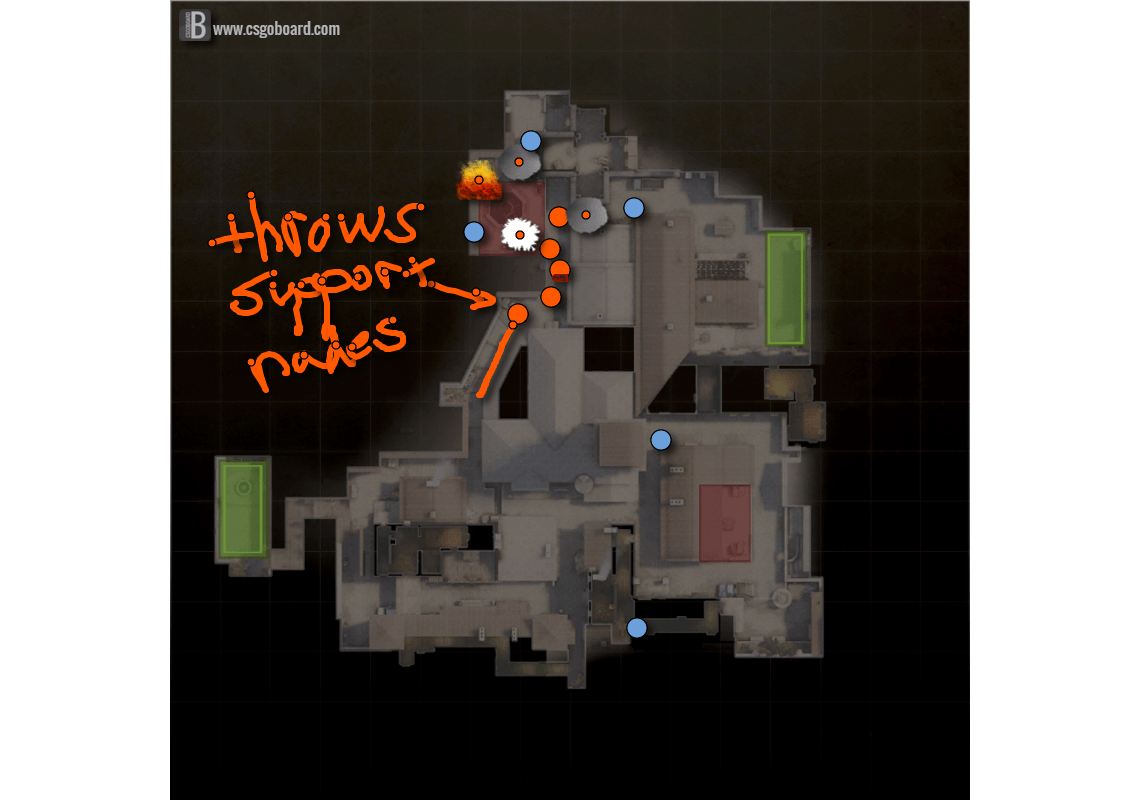
Late Game
The late game in chess is typically when both sides are down to a few major pieces and pawns and they've both survived the attacks of one another. The late game is all about tactics, predicting the opponents moves, and capitalizing on their weaknesses. In CSGO the late game is when you enter either after-plant situations and 2vX/1vX situations.
There are three types of late game situations
1. Bomb is planted
2. Bomb is down.
3. It is a 2vX or 1vX (and vice-versa)
Pretty basic right? Anything other than this generally considered mid game. So let's go over late game strategies and how to handle them.
1. In the case as T that bomb is planted your one and only job is to protect the bomb. Try to ask your team where the bomb is planted and where you can see it from. Depending on how many players on your team are still alive you should be playing either a position in which you are hidden and will only peak out to kill a CT who is defusing or oblivious to where you are and is an easy kill, or you should be watching important spots of entry onto the site and try to keep the CT from getting into site at all. If you have 3-5 people then you should generally have 2-3 people holding angles while with only 1-2 player you may not want to be in the open watching angles. While as a CT your job is to get into site and defuse the bomb so you need to bait the terrorists out of their hiding spots so you can get the kill on them. Retakes are difficult but with communication and team work you can trade kills and force the Ts into an unfavorable position.
2. In the case that bomb is down as a T you really only have two choices, kill all the CTs or grab the bomb when they aren't paying attention and run for a plant. In general, the latter is the most difficult. This is all contextual, if you have smokes and flashes still in the late game, then maybe it'll be easier to cut off vision and snag the bomb. However if the bomb is down in banana of Inferno, it might just be easier to kill the CTs because you know where they are going to be watching the bomb from. Assess the spot that the bomb is down at and approach it with the best possible option; kill them or grab and run for the bomb plant. As a CT all you need to do is make sure no one can get to that bomb, you need to have someone with eyes on the bomb at all times and your team needs to make sure there's no point of entry for the terrorists to grab it.
3. 2vX and 1vX situations are always very contextual and there is never a set answer on how to deal with them. However, you always have options. As a T you are going to either plant, go for the kill, or save. Again it all depends on the context. If you are in a 1v5 maybe it would be better to just save the gun and armor and bring it to the next round, if you are in a 1v3 a plant is more ideal, and in a 1v1 you could plant or go for the kill. This again is all based on what is best for the situation.
If you are on B site on Mirage and you know the CT is in market, maybe you should fake plant and peak out for the kill. If you are in a 2v1 you could have one plant and have the other one hold an angle like apartments where it's hard for the CT to kill them and they can see the bomb. Again this all depends on the situation. However, always keep in mind that when you have the numbers advantage you always want to play it safe. No rushing or plays need to be made. If you are in a 3v1 and you planted the bomb, no one need to go hunting, and if you give them the chance it will turn into a 2v1 then a 1v1 and soon enough you might have loss the round. If you find yourself in a situation with less people like as 1v3, 1v4, 1v5, 2v4, or 2v5 and it is an absolutely vital round to win and you cannot save, you need to make plays.
The best way to make plays in a 2vX is to communicate with your teammate and flash, crossfire, and support each other. In a 1vX you need to constantly give yourself 1v1 situations. If you need to make a play then whittle them down from five players to four, four to three, three to two, and suddenly the round is now possible. Running into a 1v3 in the open will always get you killed and you won't win unless you're at a level way above the other players. Play smart.
So to conclude this article, you need to recognize the patterns the rounds follow. Early game is the time for setting up and covering your bases or using a set strategy, mid game is about progressing your goal based on the early game information, and late game is about taking what little resources you and/or your opponent has left and finding a way to end the round based off of that advantage or disadvantage. Anyways, thank you for reading I really do hope that it helped, I also hope that my chess metaphors didn't bore you to sleep! Have fun and keep ranking up!
Are you into fantasy leagues? Then check out AlphaDraft and put together your allstar lineup!